

How Big Is 7 cm? 6 Objects That Show Its Exact Size
Seven centimetres equals 70 millimetres, or about 2.76 inches. It is a little shorter than 3 inches. To picture this length, imagine a straight line measuring 70 mm on a ruler.
Finding everyday objects that are exactly 7 cm can be difficult. Many things, such as fruit, balls, and household items, come in different sizes. Their measurements can change from one brand or model to another.
This guide uses manufactured reference objects with a specified 70 mm dimension. These examples are more reliable than guessing an ordinary object’s size. Where a standard allows a small manufacturing tolerance, I explain that too.
How Big Is 7 cm?
7 cm is a short length that can fit across part of your palm. It is longer than 2.5 inches but shorter than 3 inches.
Here are the basic conversions:
| Measurement | Equivalent |
| Centimetres | 7 cm |
| Millimetres | 70 mm |
| Inches | 2.76 inches |
| Feet | 0.23 feet |
| Metres | 0.07 metres |
| Yards | 0.077 yards |
The most useful conversion to remember is that 7 cm equals 70 mm. If you have a ruler marked in millimetres, you can find this length by counting 70 small divisions from the zero mark.
Related Post: How Big is 6 cm?
Six Manufactured Objects That Measure 7 cm
The following examples use objects designed or cut to a stated 70 mm dimension. For a true exact match, check the product specification or have the object measured. A product’s stated size can still have a manufacturing tolerance.
| Object | Dimension to look for |
| 70 mm acrylic square | 70 mm on each side |
| 70 mm wooden cube | 70 mm on each edge |
| 70 mm round metal disc | 70 mm diameter |
| 70 mm wooden dowel section | 70 mm length |
| 70 mm metal spacer | 70 mm length |
| 70 mm cinema film | Nominal 70 mm width |
1. A 70 mm Acrylic Square
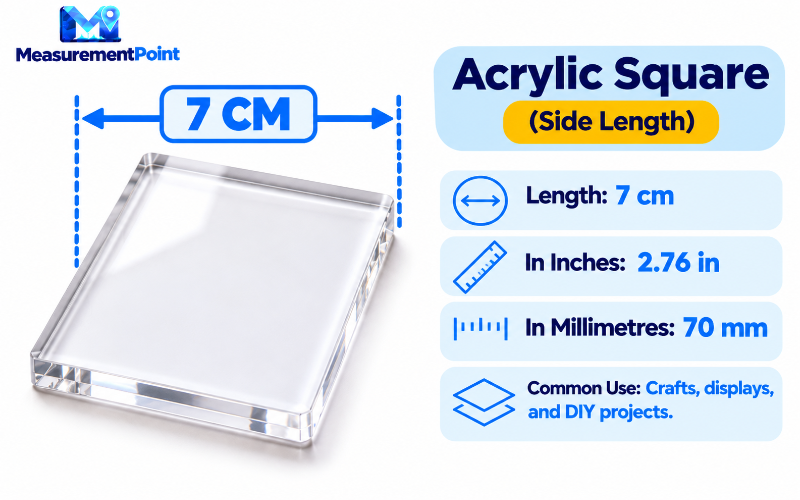
A square acrylic piece made to measure 70 mm on each side is a simple way to see the size of 7 cm. It has four equal sides, and each side measures 7 cm.
You can use this type of piece as a craft sample, display component, or measurement reference. Its flat shape makes the measurement easy to understand. Place a ruler along one edge, and you should see the distance from zero to the 70 mm mark.
When buying one, look for a product listing that gives its dimensions as 70 × 70 mm. Do not rely on a listing that only says it is approximately 7 cm. Also check whether the seller gives a cutting tolerance, because a small difference may occur during production.
2. A 70 mm Wooden Cube
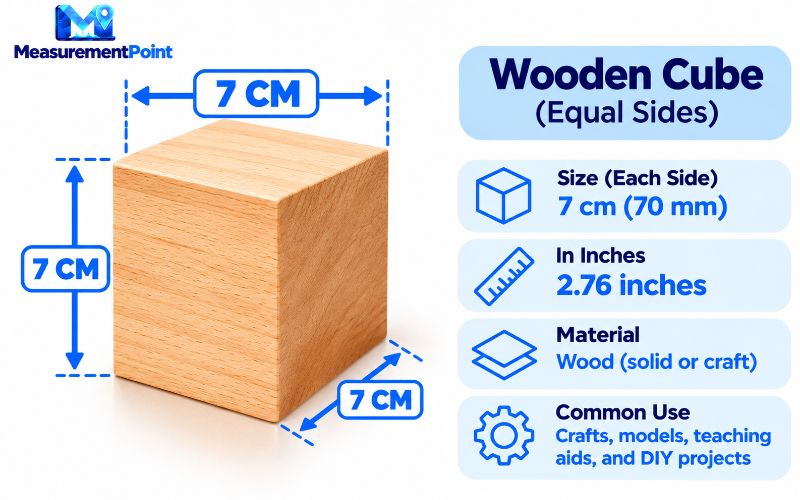
A wooden cube made to 70 mm on every side is another clear example. Each of its six square faces measures 7 cm across and 7 cm high.
This is different from an ordinary toy block, which may have a smaller or larger size. For this comparison, choose a cube that is specifically made with dimensions of 70 × 70 × 70 mm.
A cube is useful because you can compare the same measurement in three directions. Its height, width, and depth are all 7 cm. You can hold it in your hand or place it beside a ruler to understand how much space 70 mm takes up.
3. A 70 mm Round Metal Disc
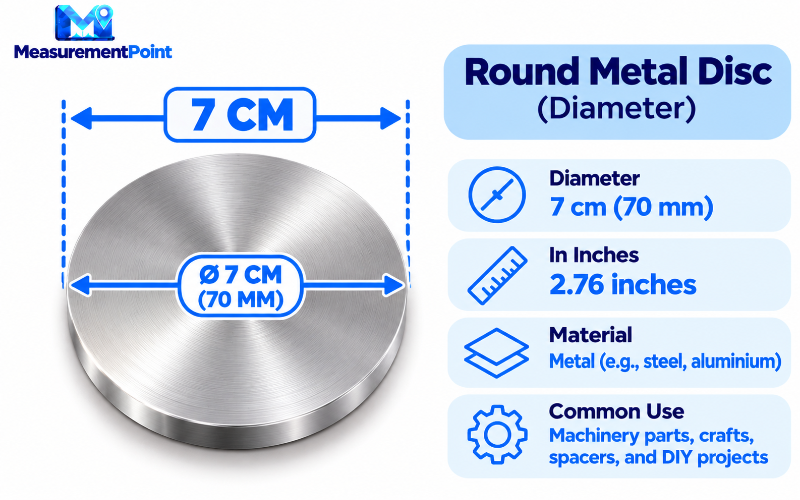
A round metal disc manufactured with a 70 mm diameter gives you another way to visualise 7 cm. Diameter means the straight distance from one side of a circle to the opposite side, passing through its centre.
For this comparison, the important measurement is not the disc’s thickness. It is the distance across its widest point.
You may find made-to-size metal discs used in craft projects, engineering work, signs, and custom components. Check the listed diameter before using one as a reference. A disc described as 70 mm wide may have a small production tolerance, so the manufacturer’s specification matters.
4. A 70 mm Wooden Dowel Section
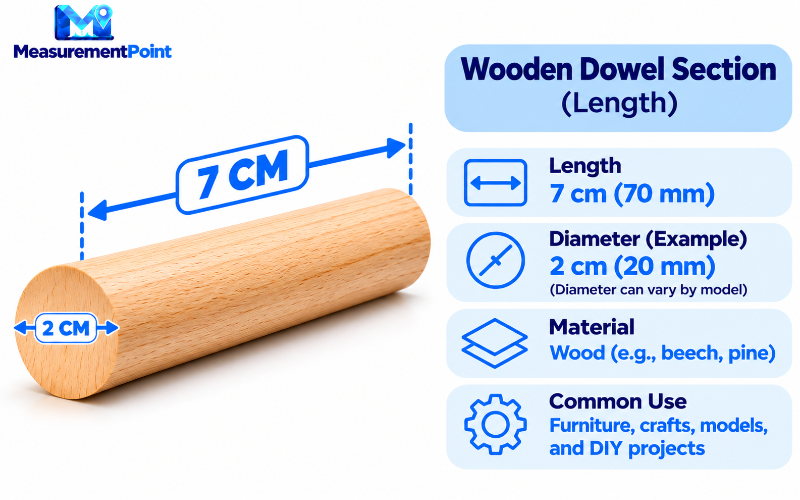
A wooden dowel can be cut to a length of exactly 70 mm. A dowel is a round wooden rod often used in furniture, crafts, and small building projects.
For this example, measure the length from one flat end to the other. The rod’s diameter is a separate measurement and does not need to be 70 mm.
A 70 mm section is a useful comparison because it is a straight length rather than a flat surface. Place it beside a ruler, and its end should line up with the 70 mm mark. If you cut one yourself, mark the measurement carefully and account for the width of the saw blade when making the cut.
Related Post: How Big is 5 cm?
5. A 70 mm Metal Spacer
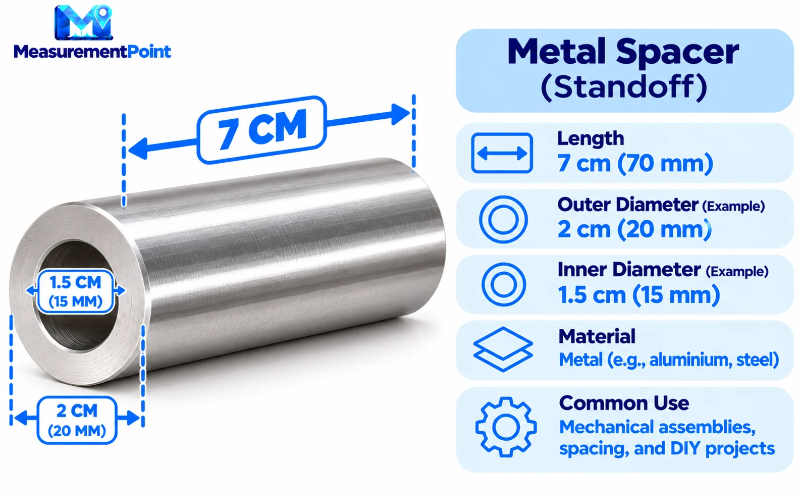
Some machines and mechanical assemblies use spacers to keep parts at a set distance. A metal spacer can be manufactured with a length of 70 mm.
For this example, the relevant measurement is the spacer’s overall length. Its outside diameter, inside hole, and thickness may be different, depending on its design.
A spacer made to a 70 mm specification can help you picture the length of 7 cm. When choosing one, read the technical drawing or product details carefully. Some listings use measurements for the outer diameter rather than the overall length. Make sure the stated 70 mm refers to the dimension you want to compare.
6. A 70 mm Cinema Film Strip
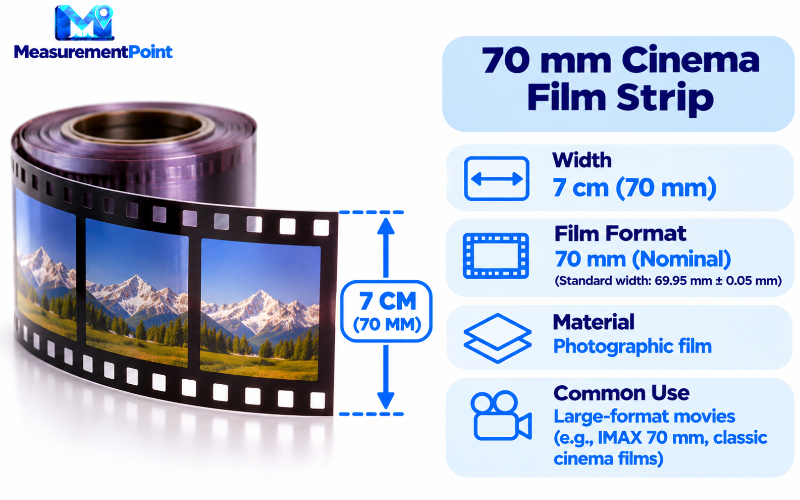
A 70 mm cinema film strip is a real-world example of a film format named for its width. It is used for large-format motion-picture projection.
There is one detail worth knowing: the ISO specification gives the width of 70 mm film as 69.95 mm with a tolerance of ±0.05 mm. That means it is a nominal 70 mm format, not a guarantee that every strip measures precisely 70.00 mm.
This makes it a useful example of how the 7 cm measurement appears in professional equipment and film production. It is also a good reminder that a nominal measurement and an exact measured value are not always the same thing.
Related Post: How Big is 4 cm?
How Long Is 7 cm on a Ruler?
To see 7 cm on a ruler, find the zero mark and move along to the 7 cm mark.
If your ruler uses millimetres, look for the 70 mm mark instead. There are 10 millimetres in every centimetre, so seven centimetres contain 70 millimetres.
The distance between the two marks is the length you want. Make sure the ruler starts at zero rather than at its physical edge, as some rulers have a small gap before the first marking.
How Big Is 7 cm in Inches?
Seven centimetres equals approximately 2.76 inches.
You can calculate this by dividing 7 by 2.54, because one inch is exactly 2.54 centimetres.
| Centimetres | Inches |
| 1 cm | 0.39 in |
| 2 cm | 0.79 in |
| 3 cm | 1.18 in |
| 4 cm | 1.57 in |
| 5 cm | 1.97 in |
| 6 cm | 2.36 in |
| 7 cm | 2.76 in |
| 8 cm | 3.15 in |
| 9 cm | 3.54 in |
| 10 cm | 3.94 in |
So, 7 cm is slightly less than 2¾ inches.
Related Post: How Long is 3 Inches?
How Big Is 7 cm in Height?
When something is 7 cm tall, its height from the bottom to the top is 70 mm. It is a little less than 3 inches.
Height is different from width and length. For example, a square piece measuring 70 × 70 mm has both a height and a width of 7 cm when viewed upright. A wooden rod cut to 70 mm has a length of 7 cm, but its diameter may be much smaller.
Always check which direction a measurement describes before comparing two objects.
Is 7 mm the Same as 7 cm?
No. These measurements are very different.
- 7 mm is 0.7 cm.
- 7 cm is 70 mm.
Seven centimetres is ten times as long as seven millimetres. Mixing up these units can cause a major measurement error, especially when reading product specifications or medical reports.
How to Measure 7 cm Without a Ruler
A ruler or measuring tape is the best way to check 7 cm accurately. If you do not have one, you can make a temporary reference:
Use a strip of paper: Mark a starting point and measure 7 cm using a ruler when one becomes available. Keep the marked strip as a reference.
Use a phone measurement tool: Some phones offer measuring apps that use the camera. These can help with a rough estimate, but they may not be accurate enough for precise work.
Use a 70 mm reference piece: A verified 70 mm object, such as a cut-to-size acrylic square or wooden dowel, can help you compare another item. Check its actual measurement first.
Avoid assuming that your finger, palm, or another body part is exactly 7 cm. Hand sizes vary from person to person.
What Does a 7 cm Measurement Mean in Medical Reports?
The phrase “7 cm” can appear in medical reports describing cysts, fibroids, tumours, stones, or cervical dilation. The measurement alone does not tell you what a finding means or what treatment is needed.
How Big Is a 7 cm Cyst?
A cyst measuring 7 cm is 70 mm across if the report is describing its diameter. Its significance depends on where it is, what it looks like on imaging, and whether it causes symptoms.
For example, guidance from the Royal College of Obstetricians and Gynaecologists discusses follow-up for some simple ovarian cysts measuring between 5 and 7 cm before menopause. Larger cysts may need further assessment. This guidance does not apply to every type of cyst or every patient.
How Big Is a 7 cm Tumour?
A tumour measuring 7 cm is 70 mm in the dimension stated in the report. However, size alone cannot establish whether a tumour is cancerous or determine its stage.
Doctors consider the tumour’s location, type, spread, and other test results. A medical professional must interpret the measurement in its full clinical context.
How Big Is a 7 cm Fibroid?
A 7 cm fibroid measures 70 mm. Fibroids are growths that develop in or around the uterus, and their effects can vary.
Their location, number, symptoms, and the person’s health and pregnancy plans can all affect treatment decisions. A measurement by itself does not determine whether treatment is necessary.
Is 7 cm Dilated a Lot?
In labour, cervical dilation is measured in centimetres. A measurement of 7 cm means the cervix has opened to 7 centimetres.
The American College of Obstetricians and Gynecologists identifies 6 cm as the start of the active phase of labour. However, dilation does not tell you exactly when delivery will happen. Labour progress varies, and the care team should interpret the measurement alongside other signs.
How Big Is a 7 cm Gallstone?
A gallstone measuring 7 cm would be unusually large. Gallstones are commonly much smaller, and a stone of this size should be assessed by a medical professional.
Do not use the size alone to decide whether a stone needs treatment. Symptoms, location, and possible complications are important.
How Big Is a 7 cm Kidney Stone?
A kidney stone measuring 7 cm would be exceptionally large. It is also important not to confuse 7 cm with 7 mm. The latter is much smaller, although even a stone of 7 mm may cause problems passing naturally.
A suspected kidney stone needs medical assessment. Severe pain, fever, vomiting, or difficulty passing urine should be treated as reasons to seek urgent medical advice.
FAQs
Is 7 cm bigger than 2 inches?
Yes. Two inches equal 5.08 cm, so 7 cm is longer by 1.92 cm.
Is 7 cm close to 3 inches?
Yes. Seven centimetres is about 2.76 inches, which is slightly shorter than 3 inches.
How many millimetres are in 7 cm?
There are 70 millimetres in 7 centimetres. Multiply the centimetre measurement by 10 to convert it to millimetres.
Can I use my hand to measure 7 cm?
You can use your hand for a rough estimate, but finger and palm sizes vary. Use a ruler or a verified 70 mm reference object when accuracy matters.
Is a 70 mm object exactly 7 cm?
A dimension of 70 mm is equivalent to 7 cm. However, a manufacturer’s stated measurement may include a tolerance. Check the specification if you need an exact physical measurement.
Conclusion
Seven centimetres equals 70 millimetres or approximately 2.76 inches. It is a little shorter than 3 inches.
For a dependable comparison, use an object with a clearly stated 70 mm dimension, such as a made-to-size acrylic square, wooden cube, metal disc, dowel section, or spacer. A 70 mm cinema film strip is another useful nominal-size example, although its standard allows a small tolerance.
If accuracy matters, measure the object with a ruler or calliper rather than relying on appearance alone.

One Comment