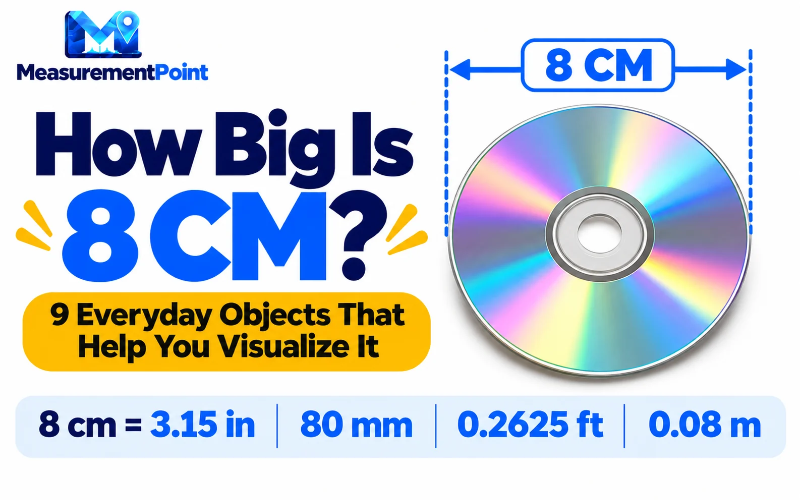
How Big Is 8 cm? 9 Objects That Show Its Actual Size
Eight centimetres is equal to 80 millimetres, 3.15 inches, or 0.2625 feet. It is slightly longer than 3 inches and is a useful size to recognise when measuring small household items, craft materials, and accessories.
If you are trying to picture how big 8 cm actually is, imagine a small round disc measuring 8 cm across or a square tile with each side measuring 8 cm. These examples give you a much clearer idea than simply looking at a number.
In this guide, you will see nine objects that help you visualise 8 cm. Some have standardised dimensions, while others are custom-made or cut to exactly 8 cm. I will explain which part of each object is being measured so you do not confuse its length, width, height, or diameter.
Related Post: How Big is 7 cm?
How Big Is 8 cm?
An 8 cm measurement is a little over 3 inches long. It is not a particularly large distance, but it is easy to notice when placed beside a small household object.
Here are the main conversions:
| Measurement unit | Equivalent |
| Centimetres | 8 cm |
| Millimetres | 80 mm |
| Inches | 3.15 inches |
| Feet | 0.2625 feet |
| Metres | 0.08 metres |
| Fraction of a foot | Approximately ¼ foot |
The inch conversion comes from dividing 8 by 2.54. The result is 3.1496 inches, which rounds to 3.15 inches.
For a simple comparison, 3 inches equals 7.62 cm. That means 8 cm is 0.38 cm, or 3.8 mm, longer than 3 inches.
9 Objects That Help You Visualise 8 cm
The following objects offer different ways to picture this measurement. Some are standardised products, and others are examples that can be made to the required size.
1. An 80 mm Mini CD
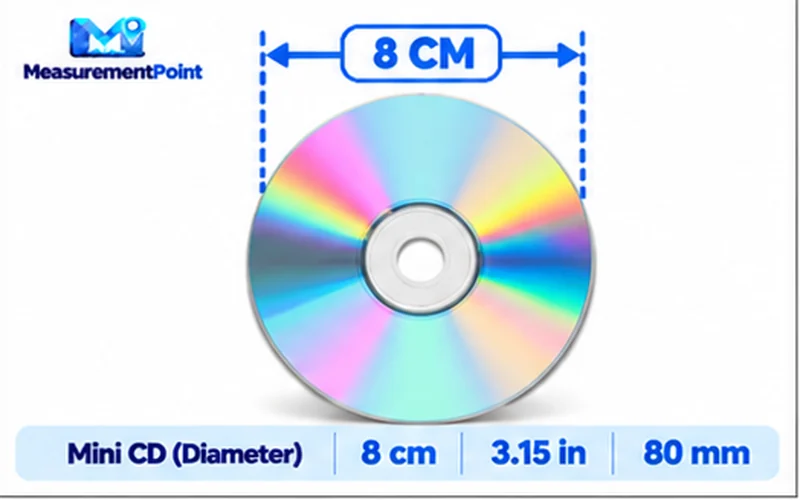
A mini CD is one of the easiest round objects to use when picturing 8 cm. Its standard diameter is 80 mm, which is exactly 8 cm.
Unlike a full-size CD, which measures 120 mm across, a mini CD has a much smaller circular shape. You can hold it in your hand and look directly across its centre to understand the measurement.
The important point here is that we are measuring its diameter, not the distance around its outside edge. Diameter means the straight-line distance from one side of a circle to the opposite side, passing through its centre.
If you have an old mini CD or a compatible small disc, place it beside a ruler. The distance across its widest point gives you a direct visual example of 8 cm.
2. An 80 mm Computer Case Fan
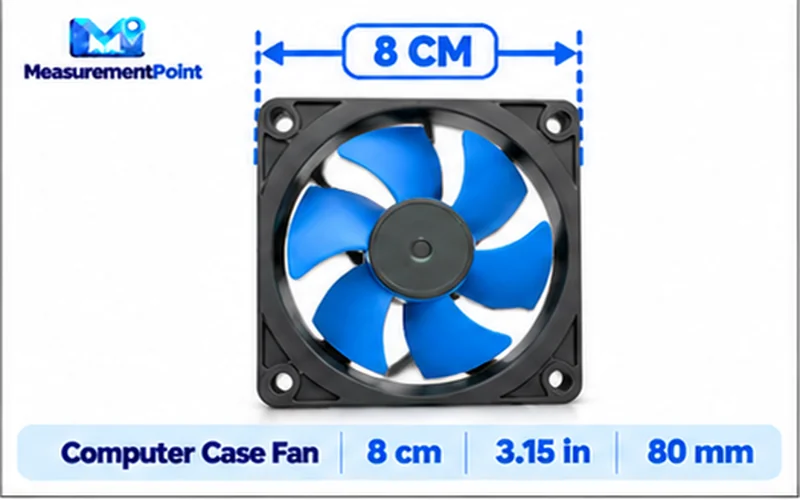
A small computer case fan with an 80 mm frame is another useful example. Its square frame measures 80 mm along each side, making each side equal to 8 cm.
These fans are used to move air through computer cases and electronic equipment. You may see them listed as 80 mm fans when shopping for computer cooling parts.
Look at the outside frame rather than the circular fan blades. The frame is square, so you can measure from one outside edge to the opposite edge to get 8 cm.
This is a particularly helpful comparison because it shows the measurement as a straight side rather than a circular diameter. It also gives you a sense of how much space an 8 cm square takes up.
3. An 80 mm Inline Skate Wheel
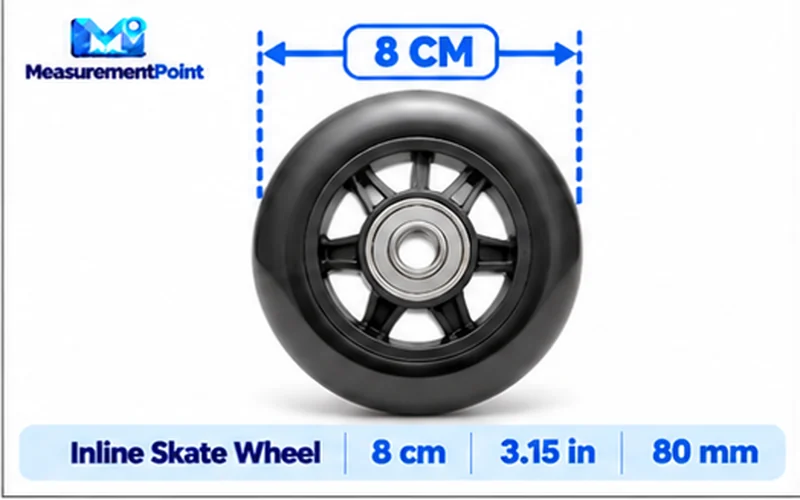
Some inline skates use wheels with an 80 mm diameter. This makes an 80 mm wheel a close-to-perfect visual reference for 8 cm.
To understand its size, imagine a straight line running through the centre of the wheel from one outside edge to the other. That line is the diameter, and on an 80 mm wheel it measures 8 cm.
Skate wheels come in several sizes, so not every inline skate wheel will match this measurement. Check the size printed on the wheel or its product specifications before using it as a reference.
An 80 mm wheel is useful because it helps you understand how large an 8 cm circle looks in real life. You can also compare its diameter with the length of a ruler to see the difference between a round measurement and a straight measurement.
4. An 8 cm Wooden Cube
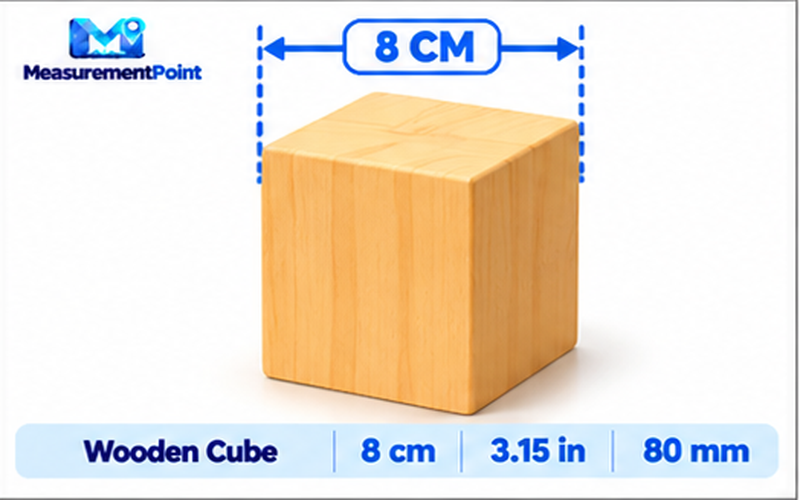
A wooden cube made to measure 8 cm on every side is a simple way to picture this size in three dimensions.
Each face of the cube is a square measuring 8 cm by 8 cm. Its height, width, and depth are also 8 cm. This makes it different from a flat strip or a round disc because it shows the same measurement in all three directions.
You can use a custom-cut wooden cube for craft work, classroom demonstrations, model-making, or small display projects. The exact dimensions depend on how accurately the cube is cut and finished.
When you hold one, pay attention to the distance from one corner to the next along a straight edge. That edge is 8 cm long.
A cube is particularly useful if you are trying to understand what an 8 cm object looks like in terms of overall volume, rather than just its length.
5. An 8 cm Acrylic Square
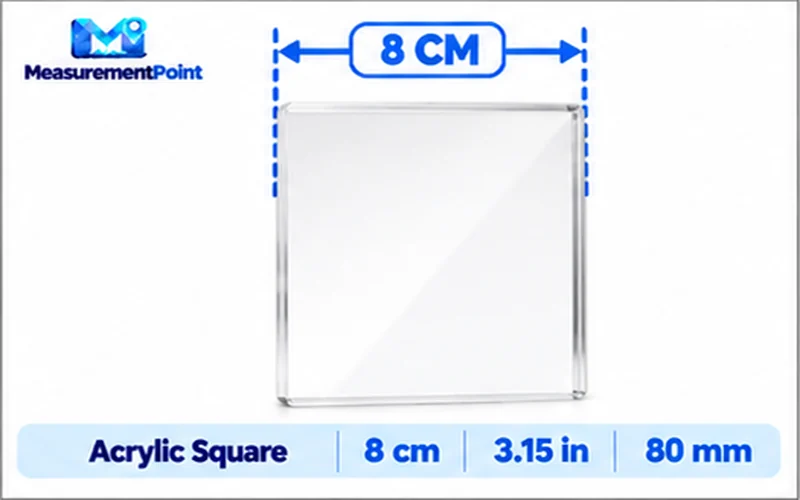
An acrylic square cut to 8 cm on each side is another clear comparison. It can be made from transparent, coloured, or frosted acrylic sheet.
The square has four sides, each measuring 8 cm. Its surface is 8 cm wide and 8 cm high. The thickness is a separate measurement and may be much smaller.
Transparent acrylic is helpful because you can see the background through it. This makes the square outline easy to compare with a ruler or another object.
You may come across acrylic squares in craft projects, display pieces, signs, small protective panels, and DIY decorations. However, ordinary acrylic sheets are sold in many sizes. Only a piece cut to the specified dimensions should be treated as an exact 8 cm example.
6. An 8 cm Round Metal Disc
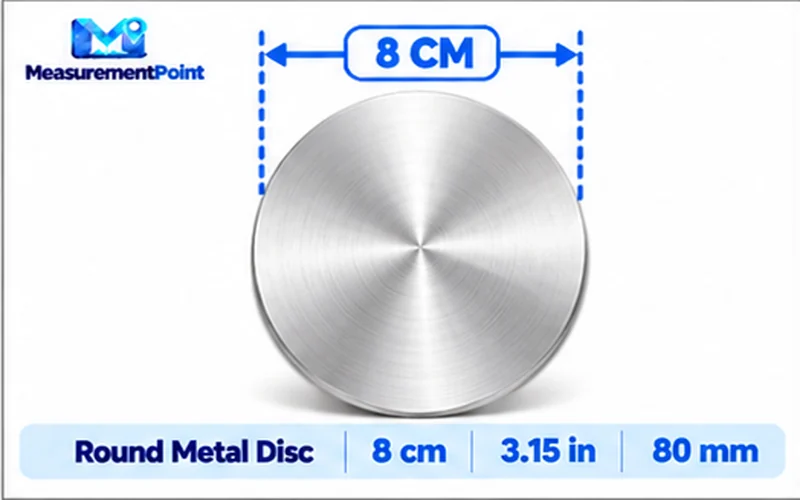
A round metal disc made with an 8 cm diameter provides another straightforward comparison.
It could be made from aluminium, steel, brass, or another suitable metal. The material does not change the measurement. What matters is the distance straight across the circular face, through its centre.
An 8 cm disc is 80 mm wide from one outside edge to the other. Its circumference, which is the distance around the outside, is a different measurement.
Small metal discs can be used in workshop projects, model-making, craft work, and custom hardware. If you are ordering one, check that the supplier lists the diameter as 80 mm rather than the circumference.
This example is especially useful if you searched for how big 8 cm is in diameter. Picture a flat metal circle with a straight line of 8 cm running through its middle.
7. An 8 cm Craft Foam Strip
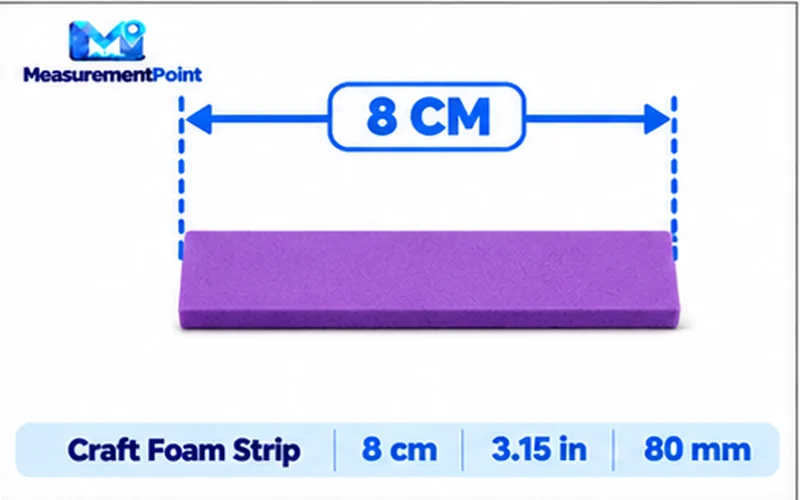
A craft foam strip cut to 8 cm in length gives you a soft, lightweight comparison.
Craft foam is available in different colours and thicknesses. It is often used for school projects, handmade decorations, costume accessories, and children’s craft activities.
For this example, the measurement refers to the strip’s length from one short end to the other. Its width and thickness can be different.
You can cut a piece of foam to exactly 8 cm using a ruler and a craft knife or scissors suitable for the material. Mark the 8 cm point first, then make a straight cut.
The finished strip gives you a simple way to see how long 8 cm is without needing a large or heavy object. It is also useful when you want to compare a short measurement with a longer sheet of material.
8. An 8 cm PVC Pipe Section
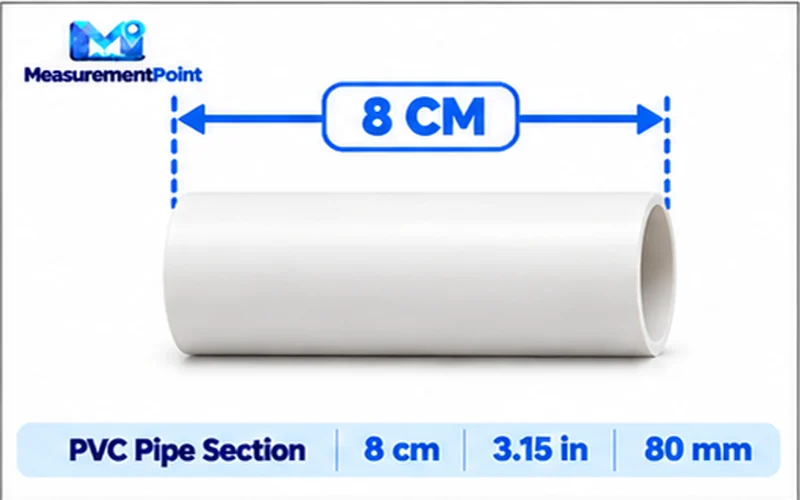
A short PVC pipe section cut to 8 cm long is another practical example.
PVC pipes are commonly used in plumbing, drainage, and DIY projects. They come in different diameters, wall thicknesses, and lengths, so a normal pipe section should not automatically be assumed to be 8 cm long.
For this comparison, measure the pipe from one cut end to the other along its length. The distance should be 80 mm.
The pipe’s diameter is a separate measurement. For example, a pipe can be 8 cm long while its opening is only a few centimetres across. Keeping these two measurements separate avoids confusion.
An 8 cm pipe section can help you visualise the length of a small fitting or connector. It is a useful comparison for people working with short pipe pieces, model plumbing, and DIY projects.
9. An 8 cm Square Ceramic Tile
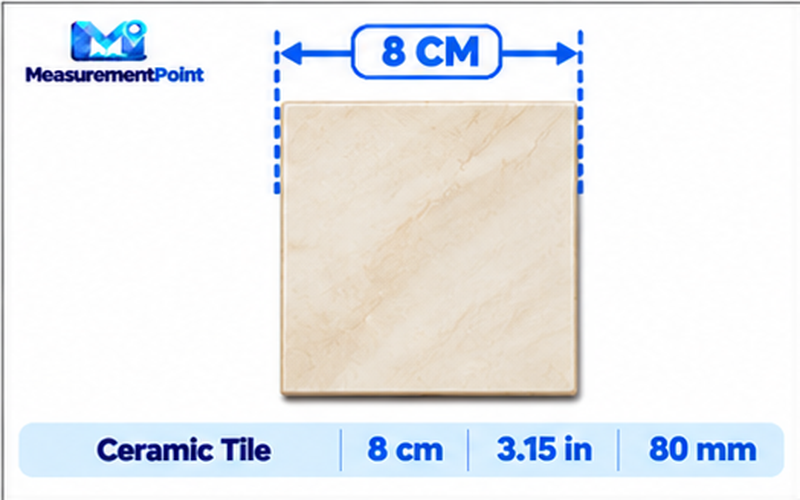
A square ceramic tile made to measure 8 cm on each side is the final comparison.
Each side of the tile measures 8 cm, so the tile is 8 cm wide and 8 cm tall. Its thickness is not included in those measurements.
You may see small ceramic squares used for mosaics, sample boards, craft projects, and decorative surfaces. However, tile sizes vary, so check the stated dimensions before using a regular tile as an exact comparison.
A tile is a good example because its flat surface makes the measurement easy to see. Place a ruler along one side, starting at zero and ending at the 8 cm mark.
If you picture this small square in your hand, you can get a good sense of how much space 8 cm covers.
Related Post: How Big is 6 cm?
How Big Is 8 cm in Inches?
Eight centimetres equals approximately 3.15 inches.
To convert centimetres into inches, divide the centimetre measurement by 2.54:
8 ÷ 2.54 = 3.1496 inches
Rounded to two decimal places, that is 3.15 inches.
Here is a quick comparison:
| Inches | Centimetres |
| 2 inches | 5.08 cm |
| 2.5 inches | 6.35 cm |
| 3 inches | 7.62 cm |
| 3.15 inches | 8 cm |
| 3.5 inches | 8.89 cm |
| 4 inches | 10.16 cm |
If you are using an inch ruler, 8 cm falls just past the 3-inch mark. It is close to 3 1/8 inches, which equals 7.9375 cm. The exact 8 cm point is slightly beyond that fraction.
What Is 8 cm in Feet?
Eight centimetres equals approximately 0.2625 feet.
To work this out, divide 8 cm by 30.48, because one foot contains 30.48 cm.
8 ÷ 30.48 = 0.2625 feet
For a simple mental estimate, you can think of 8 cm as a little more than one-quarter of a foot. One-quarter of a foot is 7.62 cm, so 8 cm is slightly longer.
Related Post: How Big is 5 cm?
How Big Is 8 cm on a Ruler?
Finding 8 cm on a metric ruler is easy.
- Place the ruler beside the object or surface you want to measure.
- Line up one end with the zero mark.
- Follow the centimetre markings until you reach 8.
- The distance from zero to 8 is your measurement.
Each centimetre contains 10 smaller millimetre divisions. Therefore, 8 cm is the same as 80 mm.
If your ruler only shows inches, look just beyond the 3-inch mark. The 8 cm point is approximately 3.15 inches.
Remember to start from zero rather than the physical edge of a ruler. Some rulers have a small blank section before the first marking, which can affect your result.
How to Measure 8 cm Without a Ruler
If you do not have a measuring tool nearby, you can use familiar items or your own hand to estimate 8 cm. These methods are useful for a quick visual check, but they should not replace a ruler when accuracy matters.
Use a Standard Payment Card
A standard bank card measures about 8.56 cm along its long edge. This is slightly longer than 8 cm.
Place the card beside the distance you want to estimate. The target measurement should be a little shorter than the card’s long edge.
Use Three Inches as a Starting Point
Three inches equals 7.62 cm. Imagine a line that is just a little longer than 3 inches.
The extra distance is 3.8 mm, which is less than half a centimetre. This is a useful mental reference when you are familiar with inch measurements.
Use Your Fingers as a Rough Guide
Four adult fingers placed side by side may come close to 8 cm for some people. However, hand sizes differ, so this method is not reliable for exact measuring.
You can compare your fingers with a ruler once and learn how close your own hand comes to the measurement.
How Big Is an 8 cm Tumour or Mass?
An 8 cm tumour or mass measures 80 mm, or about 3.15 inches, across if the report is describing its diameter. That is a noticeable size, but the measurement alone cannot tell you whether a mass is cancerous or harmless.
The word mass is a general medical term for an area of abnormal tissue or a lump. A tumour can be benign or malignant, and its meaning depends on its location, appearance, growth, and test results.
Doctors may use imaging scans, physical examinations, laboratory tests, or a biopsy to understand what a mass is. The appropriate next step depends on the individual finding and the person’s medical history.
If a scan or report mentions an 8 cm mass, discuss the result with the healthcare professional who ordered the test. Do not judge the seriousness of the finding from its size alone.
How Big Is an 8 cm Cyst?
An 8 cm cyst measures approximately 3.15 inches across if the measurement refers to its diameter. You can picture it as a round or oval structure about the size of an 8 cm disc.
A cyst is a sac-like structure that may contain fluid, air, or other material. Cysts can occur in different parts of the body, and their significance depends on where they are found and what they look like on an examination or scan.
For example, an ovarian cyst and a skin cyst are not assessed in the same way. Their location, symptoms, appearance, and other clinical details matter.
An 8 cm measurement does not automatically mean that a cyst is dangerous. However, a cyst of this size should be assessed by a qualified healthcare professional, who can explain whether monitoring, further testing, or treatment is appropriate.
Seek urgent medical help if you experience severe or sudden pain, fainting, heavy bleeding, or other serious symptoms.
How Big Is an 8 cm Fibroid?
An 8 cm fibroid is approximately 3.15 inches in its measured dimension. If it is described by diameter, it is a little longer than 3 inches across.
Fibroids are non-cancerous growths that develop in or around the uterus. They can vary greatly in number and size. Some cause no symptoms, while others may be associated with heavy menstrual bleeding, pelvic pressure, pain, or changes in bladder habits.
The effect of an 8 cm fibroid depends on its position as well as its size. A fibroid growing toward the inside of the uterus may cause different symptoms from one growing toward the outer surface.
A healthcare professional can interpret the scan and explain what the measurement means. Treatment decisions are not based on size alone; symptoms, location, age, and personal circumstances can also matter.
How Big Is an 8 cm Kidney Stone?
An 8 cm kidney stone would measure 80 mm, or about 3.15 inches, across if the report refers to its diameter. This would be an exceptionally large measurement for a kidney stone.
Kidney stones are hard deposits that form from minerals and salts in urine. Their size, location, and effect on urine flow influence how they are assessed and treated.
An 8 mm stone and an 8 cm stone are very different measurements. Eight millimetres equals 0.8 cm, while 8 centimetres equals 80 mm. Mixing these units can lead to a major misunderstanding.
If a medical report appears to describe a kidney stone as 8 cm, confirm the measurement with the treating clinician or radiology department. It may be important to check whether the report actually says 8 mm.
Severe side or back pain, fever, vomiting, or difficulty passing urine can require urgent medical assessment.
How Big Is 8 cm Dilated?
When someone is described as 8 cm dilated during labour, it means the cervix has opened to approximately 8 centimetres. This is not the length of a baby or another object. It describes the opening of the cervix.
The cervix gradually opens during labour to allow the baby to pass through the birth canal. Full dilation is generally around 10 cm, so 8 cm means the cervix is significantly open but has not yet reached full dilation.
Labour progress varies from person to person. The time it takes to move from 8 cm to full dilation is not the same for everyone.
A midwife or doctor monitors labour and provides guidance based on the mother’s and baby’s condition. The number alone should not be used to predict exactly when birth will happen.
FAQs
Is 8 cm bigger than 3 inches?
Yes. Three inches equals 7.62 cm, so 8 cm is 0.38 cm, or 3.8 mm, longer.
How many millimetres are in 8 cm?
There are 80 millimetres in 8 centimetres. Multiply the centimetre value by 10 to convert it into millimetres.
What is 8 cm in inches on a ruler?
Eight centimetres is approximately 3.15 inches. On an inch ruler, find the point just beyond the 3-inch mark.
How big is 8 cm compared to fruit?
An 8 cm measurement is roughly in the range of the width or length of some small fruits, such as a large lime or a small apple. Fruit sizes vary, so use this only as a visual estimate rather than an exact measurement.
How big is 8 cm in diameter?
An 8 cm diameter means a straight line measuring 8 cm from one side of a circle to the other, passing through its centre. It is the same as 80 mm or 3.15 inches across.
Is 8 cm the same as 8 mm?
No. Eight centimetres equals 80 millimetres. Eight millimetres is only 0.8 centimetres, so 8 cm is ten times larger.
What is 8 cm in feet and inches?
Eight centimetres equals about 0.2625 feet or 3.15 inches.
Can I measure 8 cm with a credit card?
You can make a close estimate. A standard payment card is about 8.56 cm along its long edge, so 8 cm is slightly shorter. Use a ruler for an exact measurement.
Conclusion
Eight centimetres is equal to 80 mm, 3.15 inches, and 0.2625 feet. It is just a little longer than 3 inches, making it a small but easy-to-picture measurement.
An 80 mm mini CD, an 80 mm computer fan, and an 80 mm inline skate wheel provide useful standardised comparisons. A wooden cube, acrylic square, metal disc, foam strip, PVC section, and ceramic tile can also show the size when made or cut to the correct dimensions.
The key is to pay attention to what is being measured. A diameter is not the same as a length, and a product’s height may differ from its width. For an exact result, always check the relevant dimension with a ruler or measuring tape.