

How Big Is 5 cm? 10 Everyday Objects That Help You Visualize It
If you want to know how big 5 cm is, imagine a length just slightly shorter than 2 inches. Five centimetres (cm) equals 50 millimetres (mm), 1.97 inches, or about 0.164 feet. It is a small measurement, but it is easy to see and compare with familiar objects.
You might come across 5 cm when checking the size of a small item, choosing a craft material, reading a product description, or looking at a measurement on a ruler. It can also appear in medical reports, where a doctor may describe the size of a cyst, fibroid, or tumour.
The easiest way to picture this measurement is to compare it with objects you already recognise. In this guide, you will see 10 useful examples, learn how big 5 cm looks on a ruler, and understand how it compares with 5 mm, inches, and feet.
How Big Is 5 cm?
Five centimetres is a little less than 2 inches. If you hold your thumb and index finger about 5 cm apart, you can get a rough idea of the distance. It is also close to the width of a small square sticky note or the shorter side of a standard US business card.
The measurement can describe different dimensions. For example, an object may be 5 cm long, 5 cm wide, 5 cm tall, or 5 cm across its diameter. These are not interchangeable, so always check which direction is being measured.
Here is a quick conversion chart:
| Measurement Unit | Equivalent |
| Centimeters | 5 cm |
| Millimeters | 50 mm |
| Inches | 1.97 inches |
| Feet | 0.164 feet |
| Meters | 0.05 meters |
| Yards | 0.055 yards |
Is 5 cm the same as 2 inches? Not exactly. Two inches equal 5.08 cm, so 5 cm is 0.08 cm, or 0.8 mm, shorter. The difference is tiny, but it matters when you need an accurate measurement.
Related Post: How Big is 4 cm?
10 Everyday Objects That Help You Visualize 5 cm
Everyday objects can make a measurement easier to picture than numbers alone. Some examples below are close to 5 cm, while others are made or printed to that size. Check the stated dimension before using any object as an exact measuring reference.
| Everyday Object | Approximate Measurement | How It Compares |
| C battery | About 5 cm long | Very close to 5 cm |
| 2-inch square sticky note | 5.08 cm per side | Slightly larger |
| US business card | About 5.08 cm on the short edge | Slightly larger |
| 50 mm craft cube | 5 cm per side | Exact by design |
| 5 cm cookie cutter | 5 cm across | Exact if labelled |
| Mini embroidery hoop | 5 cm diameter | Exact if labelled |
| Small square photo print | 5 cm per side | Exact if printed to size |
| Small plum | Around 5 cm across | Approximate |
| Large strawberry | Around 5 cm long | Approximate |
| Wooden craft dowel offcut | 5 cm long when cut to size | Exact when measured |
1. A C Battery
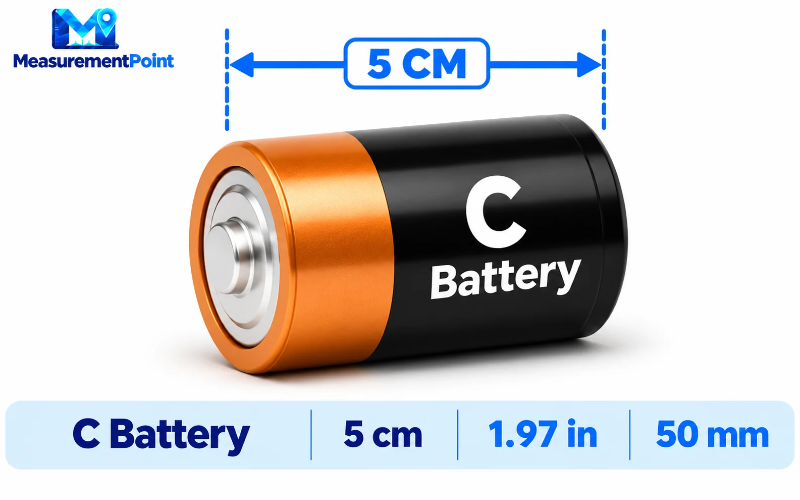
A standard C battery is a useful reference for understanding a length close to 5 cm. Its nominal length is around 50 mm, which is exactly 5 cm. This makes it a handy object to picture when you are trying to understand the measurement without a ruler.
Unlike a round coin, a C battery has a clear end-to-end length. You can imagine placing it beside a small item to see whether that item is roughly the same length. Remember that you are comparing the battery’s length, not its width or diameter.
If you have a C battery at home, place it beside a ruler and check its dimensions. It gives you a practical way to see what 5 cm looks like in real life.
2. A 2-Inch Square Sticky Note
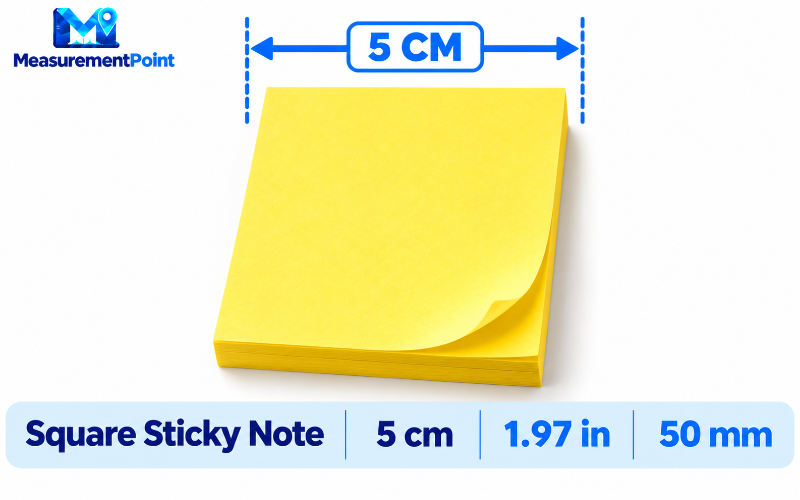
A small square sticky note measuring 2 inches on each side is another easy comparison. Since 2 inches equal 5.08 cm, each side is just 0.08 cm longer than 5 cm.
These notes are commonly used for reminders, short messages, page markers, and quick lists. Their square shape is helpful because you can compare both the height and width with the same measurement.
Place one side against a metric ruler. The edge will reach just beyond the 5 cm mark. This is a good example of how close 5 cm is to 2 inches, even though the two measurements are not exactly equal.
3. The Short Edge of a US Business Card
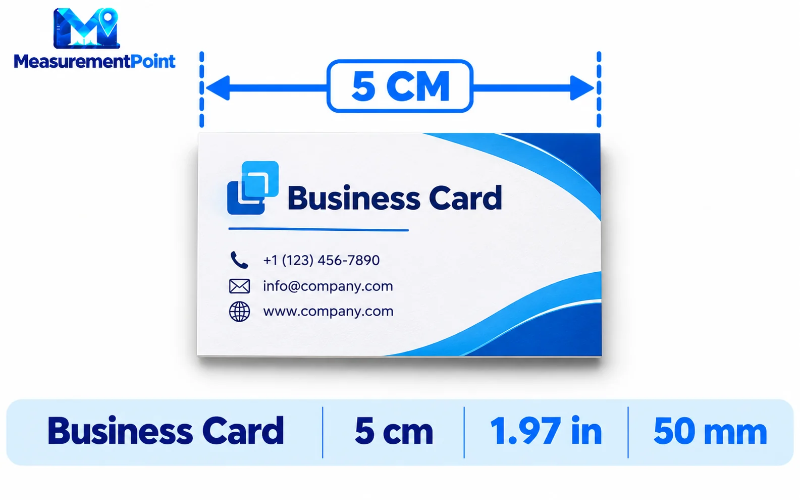
A standard US business card is about 3.5 inches long and 2 inches wide. Its shorter edge is therefore approximately 5.08 cm.
This makes the short side a useful reference when you want to picture how big 5 cm is. Hold the card upright and look at its shorter edge. That distance is just a little more than the measurement you are trying to visualise.
Business cards are also useful because they are flat and easy to place beside an object. You can compare the height of a small box, the width of a label, or the side of a craft item against the card’s short edge. Just remember that card sizes can vary by country and printer.
4. A 50 mm Craft Cube
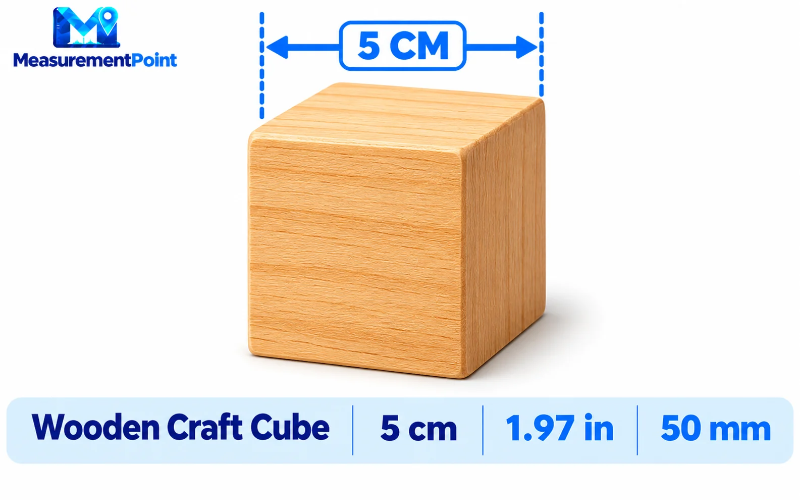
A craft cube made with 50 mm sides is an exact example of 5 cm. Each side measures 50 millimetres, and 10 millimetres make 1 centimetre.
Unlike a natural object, a cube made to this measurement has a clear and consistent size. It also helps show that 5 cm is not only a length. It can describe the height, width, and depth of an object.
You may find wooden, plastic, or foam cubes in craft and school supplies. Check the product dimensions before buying one, as craft cubes are sold in many different sizes. A cube labelled 50 mm is a particularly clear way to picture a 5 cm height or width.
5. A 5 cm Cookie Cutter
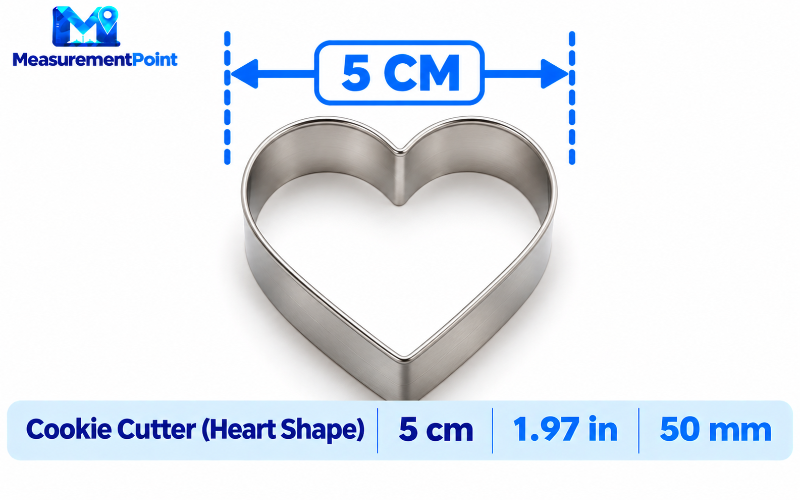
A small cookie cutter labelled as 5 cm wide gives you another simple comparison. The measurement usually refers to the width across the cutter, although the exact shape can affect how that width is described.
A round cutter is especially easy to understand. Its diameter is 5 cm from one side of the circle to the other, passing through the centre. A star or flower-shaped cutter may have a 5 cm measurement across its widest points instead.
Cookie cutters are useful examples because they show how 5 cm can describe the size of a flat shape. If you are using one as a reference, check whether the listed size means diameter, width, or height.
6. A Mini Embroidery Hoop
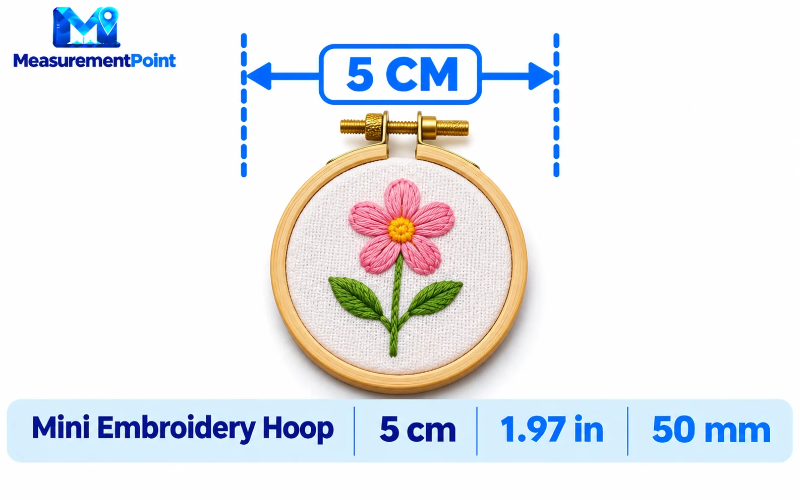
A mini embroidery hoop with a 5 cm diameter is another useful way to picture this measurement. It is a small circular frame used to hold fabric tight while someone works on embroidery or other needle crafts.
The diameter measures straight across the circle through its centre. It does not measure around the outside edge. This distinction is important when comparing circular objects with a ruler.
A hoop labelled 5 cm across gives you a clear visual example of the size. You can also place it over a drawing or small piece of fabric to see how much space a 5 cm circle takes up.
7. A Small Square Photo Print
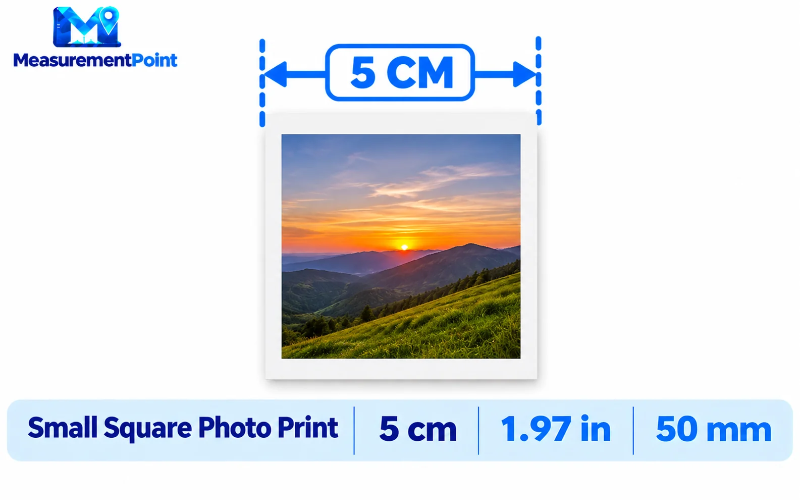
A square photo printed at 5 cm by 5 cm gives you an exact visual reference. Each side is 5 cm, and the image is large enough to see clearly while still being small enough to fit in a wallet, scrapbook, or craft project.
This example is useful because it shows the measurement as both a height and a width. It also helps when someone asks for a 5 cm picture or wants to understand how large a printed image will look.
When ordering a photo, check the final printed dimensions. A picture shown on a phone or computer screen can appear much larger or smaller depending on the display. The physical print size is what matters.
8. A Small Plum
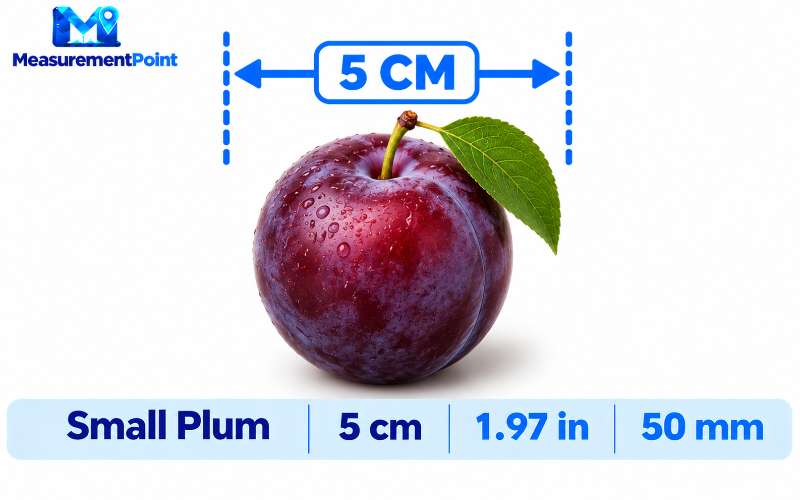
A small plum can be close to 5 cm across, although fruit sizes vary by type and growing conditions. Some plums are smaller, while others are noticeably wider.
Its rounded shape gives you a different way to imagine 5 cm. Instead of looking at a straight object, you are picturing the distance across a piece of fruit. Think of measuring from one side of the plum to the opposite side through its widest point.
This is only a rough comparison, not an exact measuring tool. If you are looking for how big 5 cm is compared to fruit, a small plum can help you form a mental picture. Use a ruler if you need the actual size.
9. A Large Strawberry
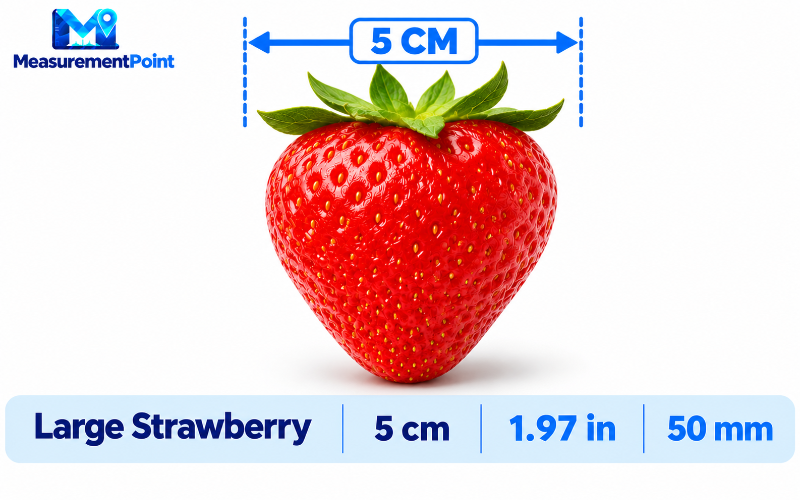
A large strawberry may measure around 5 cm from its leafy top to its pointed end. Smaller strawberries can be much shorter, and some large varieties may be longer.
This makes a strawberry a useful height or length comparison rather than a fixed standard. Look at the fruit from top to bottom and picture a 5 cm line running along its longest direction.
Fruit is not manufactured to a set size, so do not expect every strawberry to match this measurement. Still, it is a familiar example that helps make the number easier to imagine. If you are comparing fruit for a recipe or food project, measure the individual piece rather than relying on its appearance.
10. A Wooden Craft Dowel Cut to 5 cm
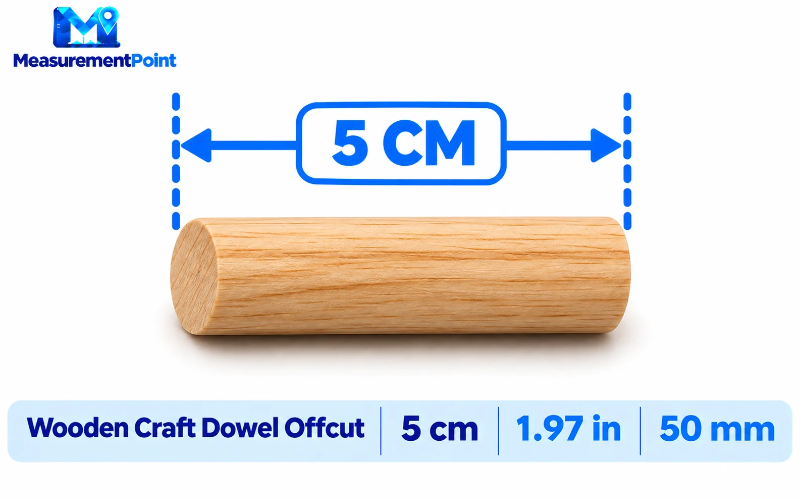
A short wooden craft dowel can be cut to exactly 5 cm. It is a simple example, but it makes the measurement easy to see because it has a straight shape and two clear ends.
Mark 5 cm on a longer dowel using a ruler, then cut it at the mark. The small piece will give you a physical reference that you can keep in a craft box or use for future projects.
This example is particularly helpful for DIY work, model making, and school activities. Unlike a fruit or household item that may vary in size, a dowel cut carefully to the 5 cm mark gives you a repeatable reference.
Related Post: How Big is 3 cm?
How Big Is 5 cm on a Ruler?
On a metric ruler, 5 cm is the distance from the zero mark to the line labelled 5. It is halfway between 0 and 10 cm.
A centimetre is divided into 10 smaller millimetres. That means the 5 cm mark comes after 50 small millimetre divisions.
Here is a simple text guide:
To measure 5 cm accurately:
- Place the ruler beside the object.
- Line up one end with the 0 mark.
- Look for the line labelled 5.
- Check that the other end reaches that mark.
- Keep the ruler straight rather than measuring at an angle.
If you are using a ruler marked in inches, 5 cm falls just before the 2-inch mark. It is approximately 1.97 inches, so it does not quite reach 2 inches.
How Big Is 5 cm in Inches and Feet?
Five centimetres equals approximately 1.97 inches. To convert centimetres into inches, divide the centimetre value by 2.54.
For this measurement:
5 ÷ 2.54 = 1.9685 inches
Rounded to two decimal places, that is 1.97 inches.
To convert 5 cm into feet, divide the inch value by 12:
1.9685 ÷ 12 = 0.164 feet
So, 5 cm is about 0.164 feet. It is a small fraction of one foot, which is why inches are usually easier to use for this particular measurement.
Is 5 cm the Same as 2 Inches?
No. Two inches equal 5.08 cm. Five centimetres is 0.8 mm shorter than 2 inches.
The difference is small enough that the two measurements can look almost identical in everyday situations. However, if you are cutting material, fitting a component, or following a precise plan, use the correct value rather than rounding automatically.
How Big Is 5 cm Visually?
If you want to know how big 5 cm is visually, imagine a short line that is nearly 2 inches long. It is longer than the diameter of a standard golf ball, which is about 4.27 cm, but not by much.
You can also picture the short edge of a small square sticky note or a 5 cm craft cube. These examples help you understand the measurement from different angles.
A helpful way to see the size is to draw a 5 cm line on paper with a ruler. Mark both ends clearly, then compare it with your thumb, a small fruit, or another familiar object. This gives you a better visual reference than relying on memory alone.
Related Post: How Big is 2 cm?
How Big Is 5 cm Height?
A height of 5 cm means the object rises 5 cm from its bottom to its top. Picture a small craft cube standing on a table, with its top surface 5 cm above the table.
The same measurement can describe the height of a small container, a craft piece, or a printed design. Always check whether a product listing gives height, width, depth, or diameter. An item that is 5 cm wide may not be 5 cm tall.
How Big Is 5 mm Compared with 5 cm?
Five millimetres is much smaller than 5 centimetres.
- 5 cm = 50 mm
- 5 mm = 0.5 cm
- 5 mm is one-tenth of 5 cm
Imagine a 5 cm line divided into 10 equal sections. Each section is 5 mm long. This is a useful way to understand the difference between the two measurements.
A 5 mm measurement is a small distance, often used for the thickness of an item or the size of a small component. A 5 cm measurement is ten times longer.
How Big Is a 5 cm Tumour, Cyst, or Fibroid?
A 5 cm tumour, cyst, or fibroid measures about 50 mm across in the direction being reported. For a simple visual comparison, imagine a line just under 2 inches long.
However, the size alone cannot tell you whether a growth is harmless or serious. Its location, type, appearance on imaging, symptoms, medical history, and other test results all matter.
How Big Is a 5 cm Tumour?
A tumour measuring 5 cm is approximately 1.97 inches across if the report is describing its largest diameter. It is important not to judge its seriousness from that number alone. Cancer staging can depend on the tumour’s location, size, local growth, lymph node involvement, and whether it has spread. Different cancer types also use different staging rules. A clinician must interpret the measurement in its full medical context. National Cancer Institute: Diagnosis and Staging.
How Big Is a 5 cm Cyst?
A cyst measuring 5 cm is about the width of a small plum. But cysts can form in different parts of the body and have different characteristics. For example, medical guidance for ovarian cysts considers whether the cyst is simple or complex, a person’s age and menopausal status, symptoms, and ultrasound findings. A 5 cm measurement does not automatically mean that a cyst is dangerous or needs surgery. Radiology: Simple Adnexal Cysts.
Related Post: How Long is 3 Inches?
How Big Is a 5 cm Fibroid?
A 5 cm fibroid is a uterine growth measuring about 2 inches across. Its effect can depend on where it sits in the uterus, how many fibroids are present, and whether it causes symptoms such as heavy bleeding, pelvic pressure, or pain. A healthcare professional can explain what the measurement means for an individual scan.
What Does 5 cm Dilated Mean?
When someone is 5 cm dilated during labour, the cervix has opened to about 5 centimetres. This is not the same as measuring the height or width of an object. It describes how far the cervix has opened.
The American College of Obstetricians and Gynecologists (ACOG) identifies 6 cm as the beginning of the active phase of labour. A measurement of 5 cm is therefore below that guideline’s active-labour threshold, but labour progress varies from person to person. Follow the advice of your maternity care team rather than judging progress from the number alone. ACOG: First and Second Stage Labor Management.
How Big Is a 5 cm Tattoo?
A tattoo that measures 5 cm is just under 2 inches across or long, depending on its shape. A 5 cm square tattoo would measure 5 cm on each side. A narrow design could be 5 cm tall but much less than 5 cm wide.
For a simple visual guide, draw a 5 cm line on paper and place your design within that space. This helps you understand how much room the tattoo may take up.
The final appearance also depends on the design, line thickness, placement, and body area. A small amount of detail can look crowded when fitted into a 5 cm space, so discuss the finished size with your tattoo artist before making a decision.
Measurement Without a Ruler: 3 Easy Ways to Estimate 5 cm
If you do not have a ruler nearby, you can still make a rough estimate.
1. Use a 2-Inch Sticky Note
A 2-inch square sticky note measures about 5.08 cm on each side. It is slightly larger than 5 cm, but close enough for a quick visual comparison.
2. Use a C Battery
The length of a standard C battery is around 5 cm. Place it beside the object you want to compare and look at the difference. Remember to compare the battery’s end-to-end length.
3. Use Your Thumb as a Rough Guide
Some adults have a thumb width or thumb section close to a few centimetres, but hand sizes vary. You can use your thumb to estimate a distance, then check it against a ruler when accuracy matters.
These methods are suitable for rough comparisons. For cutting, fitting, building, or medical measurements, use a proper measuring tool or the measurement supplied by a qualified professional.
FAQs
How big is 5 cm in inches?
Five centimetres equals approximately 1.97 inches. It is just a little shorter than 2 inches.
How big is 5 cm on a ruler?
On a metric ruler, 5 cm is the distance from the zero mark to the line labelled 5. It equals 50 small millimetre divisions.
How big is 5 cm in feet?
Five centimetres equals approximately 0.164 feet. This is also about 1.97 inches.
Is 5 cm the same as 5 cm in cm?
Yes. Five centimetres is already expressed in centimetres, so the value remains 5 cm. There is no conversion needed.
How big is 5 cm compared to fruit?
A small plum or a large strawberry may be close to 5 cm in one direction. Fruit varies in size, so these are visual comparisons rather than exact measuring references.
How big is 5 mm?
Five millimetres equals 0.5 cm. It is one-tenth of 5 cm, so it is much shorter.
Can I see how big 5 cm is without a ruler?
Yes. Compare it with a 2-inch sticky note, a C battery, or a small object that has been made to measure 5 cm. These examples help you picture the size, although a ruler is best for accuracy.
Is a 5 cm tumour always cancerous?
No. The word tumour describes an abnormal growth, and not every tumour is cancerous. Size alone cannot confirm whether a growth is cancerous. A doctor may need imaging, a biopsy, or other tests to identify it.
Conclusion
Five centimetres is a small but easy-to-picture measurement. It equals 50 mm, approximately 1.97 inches, and about 0.164 feet. It is just short of 2 inches, making a 2-inch sticky note or a C battery useful everyday references.
The most important thing is to check which dimension is being described. Length, width, height, and diameter can all be 5 cm, but they describe different parts of an object. Use familiar comparisons to build a mental picture, and use a ruler when you need an accurate result.

One Comment