
How Big Is 6 cm? 8 Everyday Objects That Help You Visualise It
Six centimetres is a small but noticeable length. It equals 2.36 inches, 60 millimetres, or 0.06 metres. To picture it, imagine a little more than two inches on a ruler. It is roughly the length of a small lemon, the width of a compact jar lid, or the length of a miniature toy car.
Although 6 cm may sound like a simple measurement, it can be difficult to imagine without a ruler. Everyday objects make the size easier to understand. You can compare it with items you already have at home, such as a small notepad, a bar of soap, or a makeup compact.
In this guide, you will learn how big 6 cm is in inches and millimetres, see how it looks on a ruler, and compare it with eight familiar objects. We will also explain what a 6 cm measurement means when describing height, width, diameter, and certain medical findings.
How Big Is 6 cm?
Six centimetres is equal to 2.36 inches. It is a little shorter than 2½ inches and slightly longer than two inches.
On a standard ruler, the distance starts at the 0 cm mark and ends at the 6 cm mark. It covers six small centimetre units, or sixty millimetre units.
A quick way to understand this length is to look at the width of a small household item. A round lid measuring 6 cm across, for example, would fit comfortably in your palm. A small object measuring 6 cm from end to end would be about the same length.
Keep in mind that 6 cm can describe different dimensions. It might mean an object’s length, height, width, or diameter. The measurement only makes sense when you know which direction is being measured.
Related Post: How Big is 5 cm?
How Big Is 6 cm in Inches, Millimetres, and Feet?
Here are the most useful conversions for 6 centimetres.
| Measurement unit | Equivalent |
| Centimetres | 6 cm |
| Inches | 2.36 inches |
| Millimetres | 60 mm |
| Metres | 0.06 m |
| Feet | 0.197 ft |
| Yards | 0.066 yd |
The most useful conversion to remember is:
6 cm = 2.36 inches = 60 mm
You do not need to memorise every conversion. If you mainly use inches, remember that 6 cm is a little less than 2½ inches.
Related Post: How Big is 4 cm?
8 Everyday Objects That Help You Visualise 6 cm
The following objects give you a practical idea of what 6 cm looks like. Their sizes can vary between brands and designs, so treat the examples as visual comparisons rather than fixed measurements. For an exact comparison, check the item or measure it yourself.
| Everyday object | Approximate dimension |
| Small lemon | Around 6 cm long |
| Mini retractable tape measure | Some models are around 6 cm wide |
| Round jar lid | Around 6 cm in diameter |
| Small notepad | Around 6 cm wide |
| Miniature toy car | Some models are around 6 cm long |
| Compact bar of soap | Some bars are around 6 cm long |
| Craft felt square | Can be cut to exactly 6 cm |
| Small makeup compact | Some models are around 6 cm across |
1. A Small Lemon

A small lemon is a useful way to picture a length of approximately 6 cm. Some smaller lemons measure close to this size from one end to the other, although many are longer.
Place the lemon on a table and look at its longest side. If it measures about 6 cm, you will have a good idea of how much space this length takes up. Its rounded shape also makes the comparison easy to recognise.
Lemons are not made to a standard size. One may be short and round, while another may be longer and narrow. For that reason, use a lemon as a rough visual guide rather than an exact measuring tool.
If you have a ruler, measure from the pointed end to the opposite end. You may find that your lemon is close to 6 cm, or you may need a smaller one for a better comparison.
2. A Mini Retractable Tape Measure

A mini retractable tape measure can help you understand how wide 6 cm is. Some compact models have a body that measures around 6 cm across, though the size depends on the design.
These small measuring tools are often kept in sewing kits, craft boxes, or drawers. Their compact shape makes them easy to hold and compare with a ruler.
To use one as a size reference, measure across the widest part of its casing. Do not measure the flexible tape inside it. The casing and the measuring strip are two different parts, and the width of the casing is what matters for this comparison.
A mini tape measure is especially useful because it is already associated with measuring. You can compare its body with the 6 cm mark on a ruler and see how close the dimensions are.
3. A Round Jar Lid
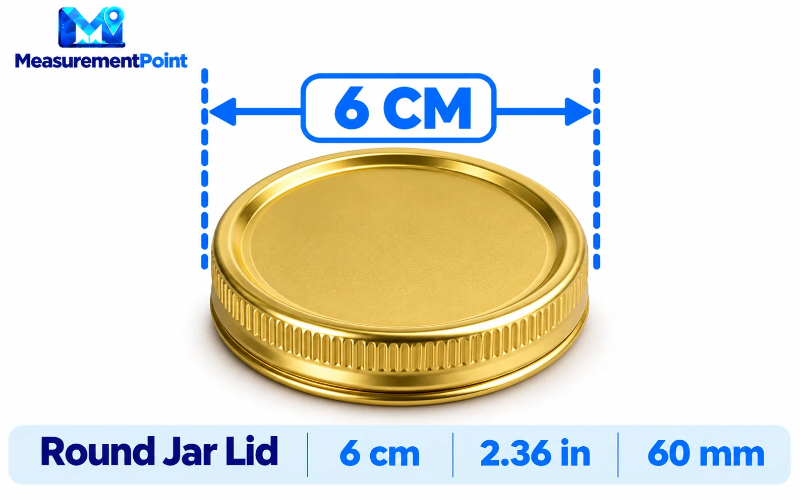
A small round jar lid measuring 6 cm in diameter is another simple example. The diameter is the straight distance from one side of the circle to the other, passing through its centre.
This is different from measuring around the outside edge. The distance around the lid is called its circumference, while the distance across its centre is its diameter.
Look for a small lid from a jar or container and measure straight across the top. If the result is 6 cm, the lid gives you an exact everyday example of this measurement.
Round lids are easy to compare because their shape makes the centre-to-centre measurement clear. They also show why it is useful to understand the type of measurement being described. A lid can be 6 cm wide without being 6 cm tall.
4. A Small Notepad

Some pocket-sized notepads are approximately 6 cm wide. They are small enough to carry in a bag or keep beside a phone, making them useful for quick notes and reminders.
To compare a notepad with 6 cm, measure across its shorter edge. Some designs will be wider than 6 cm, while others may be narrower. The exact dimensions depend on the brand and format.
A notepad is a helpful example because it has a flat, straight edge. This makes it easier to place against a ruler than a rounded object such as a lemon.
If you find a notepad that measures 6 cm across, hold it beside a ruler. You can see how the measurement covers six centimetre divisions. This gives you a clear idea of how much width 6 cm represents.
5. A Miniature Toy Car
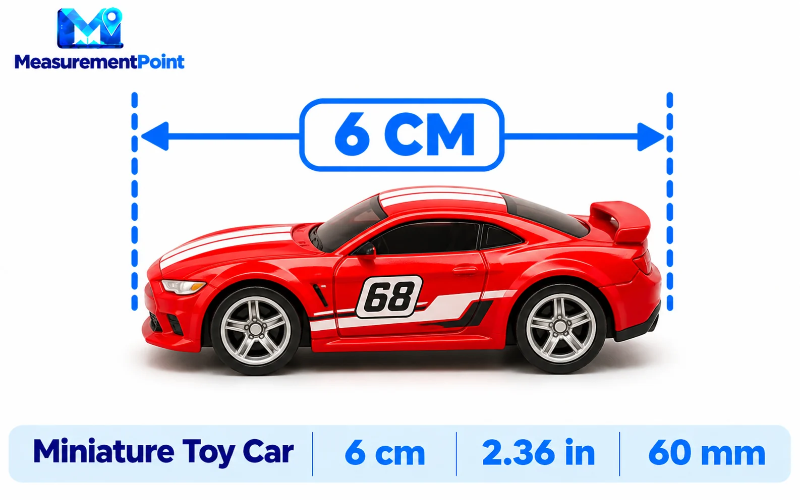
Some miniature toy cars are around 6 cm long. These small models are often designed for collections, playsets, or display, and their dimensions vary by manufacturer.
For this comparison, measure the car from its front bumper to its rear bumper. Do not include extra space around the wheels or any packaging. The length of the actual toy is the measurement you want.
A miniature car is a useful reference because its shape is familiar. You can picture it sitting in your hand and compare its length with the 6 cm mark on a ruler.
Not every miniature car will be this short. Some are much longer, especially models made in larger scales. Check the product dimensions if you want a closer match.
Related Post: How long is 2 inches?
6. A Compact Bar of Soap

A small travel-size bar of soap can be close to 6 cm long. These bars are designed to take up less space than regular bath soap, so they can be useful for visualising a short measurement.
Place the soap on a flat surface and measure along its longest straight direction. If it is around 6 cm, you can use it as a practical reference.
Soap bars come in many shapes. Some are rectangular, while others have curved edges or oval designs. Their length, width, and thickness can all be different.
This example also shows why you should check which side is being measured. A bar of soap might be 6 cm long but only 3 cm wide. The two measurements describe different parts of the same object.
7. A Craft Felt Square

A craft felt square is one of the easiest ways to create an exact 6 cm comparison. Unlike natural objects, felt can be cut to a chosen measurement.
Take a sheet of craft felt and use a ruler to mark 6 cm along one edge. Make another mark 6 cm away at a right angle. Repeat on the other sides, then cut along the lines to create a square.
You will have a piece of felt measuring 6 cm by 6 cm, assuming the cuts follow your marks accurately.
This is a particularly useful example because it shows both length and width. Each side is 6 cm, so the square gives you a clear picture of the area covered by a 6 cm measurement.
You can keep the felt square in a drawer as a quick reference. It is also useful for craft projects, small decorations, and other tasks that need a short, repeatable measurement.
8. A Small Makeup Compact

Some small makeup compacts measure close to 6 cm across. These compact cases are designed to fit into handbags, purses, or travel bags.
To compare one with 6 cm, measure across its widest part. If it is round, measure its diameter through the centre. If it is rectangular, measure the longer or shorter edge, depending on which dimension is close to 6 cm.
A makeup compact makes a useful comparison because it is a familiar object with a fairly firm outer edge. You can hold it in your hand and see how a 6 cm width looks in real life.
However, compact cases are available in many sizes. Some are smaller than 6 cm, while others are much wider. Always check the dimensions of the particular item before using it as an accurate reference.
How Does 6 cm Look on a Ruler?
A ruler is the easiest way to see exactly how long 6 cm is.
Find the centimetre scale on your ruler. Place the beginning of the object at the 0 cm mark. Follow the scale until you reach 6 cm. The distance between those two marks is the full length.
Each centimetre is divided into ten millimetres. That means the 6 cm section contains sixty millimetres.
If your ruler shows inches as well, look for the point just beyond 2¼ inches. The 6 cm mark is approximately 2.36 inches, so it sits a little past 2⅓ inches.
Tip: Start measuring at the zero mark rather than the physical edge of a ruler. Some rulers have a small gap or damaged edge that can affect your measurement.
Related Post: How Long is 12 Inches?
How Big Is 6 cm Compared to Your Hand?
Your hand can give you a rough idea of what 6 cm looks like, but it is not an exact measuring tool.
For example, the width of a finger varies from person to person. The width of your thumb may be close to a few centimetres, but it should not be assumed to measure exactly 6 cm.
You can try these simple comparisons:
- Use your thumb: Look at the width of your thumb near the nail. It can help you picture a short distance, although it will usually be less than 6 cm.
- Use two or three fingers: Place your fingers side by side and compare their combined width with a ruler. This gives you a rough visual guide.
- Use your palm: A 6 cm object will fit across part of most adult palms, but palm size varies.
If accuracy matters, use a ruler or measuring tape. Hand comparisons are best for estimating, not for tasks where a precise measurement is needed.
How to Measure 6 cm Without a Ruler
You may not always have a ruler nearby. Fortunately, you can still estimate 6 cm with a few simple methods.
Use a Measuring Tape
A flexible measuring tape is a good alternative to a ruler. Find the centimetre scale, line up the starting point, and read the measurement at the 6 cm mark.
This method works well for objects with curved surfaces, such as a small jar or compact case.
Use a Known-Size Object
Find an object whose dimensions you have already checked. A 6 cm craft square, for example, can be placed beside another item to help estimate its length or width.
Make sure the two objects are lined up at the same starting point. This makes the comparison easier to judge.
Use a Phone or Computer Screen Carefully
A phone screen can display a measurement guide, but its size changes with screen settings and scaling. A ruler image on a website may not appear at its real-world size.
If you use a digital ruler, follow its calibration instructions. Compare it with a physical ruler first if you need an accurate result.
How Big Is 6 cm in Height?
A height of 6 cm means an object measures 6 centimetres from its bottom to its top. It is the same distance as 2.36 inches.
For example, a small container might stand 6 cm tall. A compact item could also have a height of 6 cm even if its width is greater.
The important point is to look at the direction of the measurement. If someone says an object is 6 cm high, they are describing its vertical dimension, not necessarily its length or width.
For a standing object, place a ruler beside it and measure from the surface it rests on to its highest point.
Is 6 cm Big or Small?
Six centimetres is generally considered a small measurement. It is shorter than a standard smartphone’s width and much shorter than most household tools, but it is large enough to notice when looking at a small object.
Whether 6 cm is big or small depends on what you are measuring.
- For a small toy, 6 cm may be a normal length.
- For a notebook, 6 cm may be a narrow width.
- For a piece of jewellery, 6 cm may be quite large.
- For a room or piece of furniture, 6 cm is a very short distance.
- For a medical finding, its meaning depends on the body part and clinical situation.
A measurement cannot be judged properly without knowing what it describes.
What Does a 6 cm Cyst Mean?
A cyst measuring 6 cm is approximately 2.36 inches across if the measurement refers to its diameter. It may be described as a small, medium, or large cyst depending on its location and the type of cyst.
For example, ovarian cysts are assessed using factors such as their appearance on an ultrasound, symptoms, age, and whether the person has reached menopause. Size is only one part of the assessment.
A 6 cm cyst does not automatically mean cancer or another serious condition. Many cysts are benign, but some may need monitoring or treatment. A healthcare professional can interpret the scan and decide whether follow-up is needed.
If a person has sudden, severe pelvic or abdominal pain, especially with vomiting, faintness, or feeling very unwell, they should seek urgent medical attention.
How Big Is a 6 cm Tumour?
A tumour measuring 6 cm is about 2.36 inches across if the measurement refers to its widest diameter. You could compare its size with a small lemon or a compact round object, but that comparison only describes its physical dimensions.
The word tumour does not automatically mean cancer. A tumour may be benign or malignant. Its seriousness depends on several factors, including its location, type of cells, growth behaviour, and whether it has spread.
Doctors do not determine cancer stage from size alone. The staging system depends on the specific cancer and may also consider nearby lymph nodes and distant spread.
If a scan or medical report mentions a 6 cm tumour, ask the treating clinician what the measurement means in that particular case. They can explain the diagnosis and whether further tests or treatment are needed.
What Does a 6 cm Mass Mean?
A mass measuring 6 cm is a lump or area of tissue that measures about 2.36 inches in the direction being measured.
The word mass is a general medical term. It does not tell you by itself whether the finding is harmless or dangerous. A mass can be caused by different types of tissue changes, fluid-filled structures, inflammation, or growths.
Doctors consider where the mass is located, how it looks on imaging, whether it has changed over time, and whether it causes symptoms. They may recommend additional imaging, blood tests, a biopsy, or monitoring, depending on the situation.
A 6 cm mass should not be judged by its size alone. The medical report and the person’s symptoms provide important context.
How Big Is a 6 cm Fibroid?
A fibroid measuring 6 cm is around 2.36 inches in diameter. It is a little shorter than 2½ inches and can be pictured as roughly the size of a small lemon.
Fibroids are non-cancerous growths that develop in or around the uterus. They can vary greatly in size, number, and position. Some cause no symptoms, while others may lead to heavy periods, pelvic pressure, pain, or frequent urination.
A 6 cm fibroid may affect someone differently depending on where it is growing. A fibroid inside the uterine cavity can cause different symptoms from one growing on the outer wall.
Treatment is not decided by size alone. A clinician considers symptoms, location, age, pregnancy plans, and other health factors before discussing suitable options.
How Big Is a 6 cm Kidney Stone?
A kidney stone measuring 6 cm would be extremely large. It equals approximately 2.36 inches, which is far bigger than the small stones people commonly imagine when they hear the term kidney stone.
Kidney stones are usually measured in millimetres. This is why it is important not to confuse 6 cm with 6 mm.
A 6 mm stone is less than one centimetre across. A 6 cm stone is ten times that measurement in each linear dimension.
If a medical report appears to mention a 6 cm kidney stone, check the unit carefully with the healthcare professional. Do not assume the number or unit is correct without confirmation. A stone of that size would need specialist medical assessment.
Severe pain, fever, chills, vomiting, or difficulty passing urine can require urgent medical attention.
What Does 6 cm Dilated Mean?
The phrase 6 cm dilated is commonly used during labour. It means the cervix has opened to approximately 6 centimetres.
During labour, the cervix gradually opens to allow the baby to pass through the birth canal. Full dilation is generally considered to be around 10 cm.
Six centimetres is commonly used as the start of the active phase of labour in modern obstetric guidance. However, labour does not progress at exactly the same speed for everyone.
Being 6 cm dilated does not mean that delivery will happen immediately. The time remaining can vary depending on several factors, including whether it is a first birth, the baby’s position, contractions, and individual progress.
A maternity care team can explain what the measurement means in the context of a person’s labour.
What Is the Difference Between 6 cm and 6 mm?
Six centimetres and six millimetres are very different measurements.
- 6 cm = 60 mm
- 6 mm = 0.6 cm
This means 6 cm is ten times longer than 6 mm.
You can see the difference on a ruler. Six millimetres covers a short section, while six centimetres covers sixty millimetres.
This distinction is especially important when reading medical reports, product dimensions, craft instructions, or construction measurements. A small change in the unit can make a major difference to the actual size.
See Also
FAQs
Is 6 cm the same as 2 inches?
No. Six centimetres is approximately 2.36 inches. It is about 0.36 inches longer than 2 inches.
Is 6 cm close to 2.5 inches?
Yes. Six centimetres is 2.36 inches, which is slightly shorter than 2.5 inches.
How many millimetres are in 6 cm?
There are 60 millimetres in 6 centimetres. Each centimetre contains 10 millimetres.
How can I visualise 6 cm without a ruler?
You can compare it with a small lemon, a compact jar lid, or a miniature toy car. These are approximate examples, so their actual dimensions may differ.
Is 6 cm bigger than a finger?
It depends on the finger and the direction being measured. Six centimetres is usually longer than the width of one finger, but finger lengths and widths vary.
How long is 6 cm on a measuring tape?
It is the distance from the 0 cm mark to the 6 cm mark. On a millimetre scale, it covers 60 small divisions.
How much is 6 cm in feet?
Six centimetres is approximately 0.197 feet. It is a little less than one-fifth of a foot.
Is 6 cm a large size for an object?
For a small household item, 6 cm is a noticeable but compact size. For a large object, it is very small. The answer depends on what is being measured.
Is 6 cm the same as 60 mm?
Yes. One centimetre equals 10 millimetres, so 6 centimetres equals 60 millimetres.
How do I measure an object that is 6 cm tall?
Stand the object on a flat surface. Place a ruler beside it and measure vertically from the surface to the highest point. The distance should reach the 6 cm mark.
Conclusion
Six centimetres is equal to 2.36 inches or 60 millimetres. It is a little shorter than 2½ inches and can be pictured using small everyday items such as a lemon, a jar lid, a miniature toy car, or a compact makeup case.
The easiest way to understand this measurement is to compare it with an object you can hold. Remember that everyday objects come in different sizes, so use them as visual guides rather than exact standards.
If you need an accurate measurement, a ruler or measuring tape is always the better choice. And when you see 6 cm in a medical report, remember that its meaning depends on what is being measured and the wider medical context.