

How Big Is 4 cm? 9 Everyday Objects That Help You Visualize It
4 centimeters (cm) is a small length, equal to 40 millimeters (mm), 1.57 inches, or about 0.13 feet. It is roughly the diameter of a standard table tennis ball. Although 4 cm may sound like a tiny measurement, you can find similar lengths in several everyday objects around your home.
If you do not have a ruler nearby, familiar objects can make this measurement easier to picture. A small craft block, a large button, or a short piece of chalk can give you a useful idea of how long 4 cm looks.
In this guide, we will look at 9 different objects that can help you understand this measurement. Each example will give you a practical comparison, so you can picture 4 cm without needing to measure everything from scratch.
How Big Is 4 cm?
Four centimeters is a short but noticeable length. Imagine a line that starts at zero on a ruler and ends at the 4 cm mark. That distance is 4 centimeters.
To put it into perspective, 4 cm is a little more than one and a half inches. It is also the same as 40 millimeters. You might see this length when measuring small craft supplies, round objects, and compact household items.
Here are the exact conversions:
- Centimeters: 4 cm
- Millimeters: 40 mm
- Inches: 1.5748 inches (approximately 1.57 inches)
- Feet: 0.1312 feet
- Meters: 0.04 meters
One useful comparison is a standard table tennis ball. Its official diameter is 40 mm, which is exactly 4 cm. This makes it one of the easiest objects to use when imagining this measurement.
Remember that the length, width, and diameter of an object are different measurements. A round object has a diameter, while a rectangular object has a length and width. Pay attention to which part is being compared.
Related Post: How Big is 3 cm?
9 Everyday Objects That Help You Visualize 4 cm
The following nine objects offer different ways to picture a 4 cm measurement. Some have standard dimensions, while others are available in different sizes. For the adjustable examples, choose an item that measures close to 4 cm.
| Object | Approximate measurement | How it compares |
| Table Tennis Ball | 4 cm diameter | Exact 40 mm diameter |
| Golf Ball | 4.27 cm diameter | Slightly larger |
| Small Wooden Craft Cube | 4 cm side | One side measures 4 cm |
| Large Craft Button | 4 cm diameter | Similar round measurement |
| Tea Light Candle | Around 4 cm diameter | Close to the target |
| Small Craft Pom-Pom | 4 cm diameter | Similar width |
| Short Piece of Chalk | 4 cm long | Same end-to-end length |
| Small Sponge Piece | 4 cm wide | One side measures 4 cm |
| Wooden Craft Block | 4 cm long | A useful straight comparison |
1. Standard Table Tennis Ball

DIAMETER: 4 CM (40 MM)
A standard table tennis ball is one of the best examples for understanding how big 4 cm is. Its official diameter is 40 millimeters, which converts to exactly 4 centimeters.
Pick up a table tennis ball and look at its overall width. From one outside edge to the opposite outside edge, passing through the center, you will get 4 cm. This is called its diameter.
The ball is small enough to fit comfortably in your hand, but it is still easy to see and hold. You may have seen these balls in school games, sports clubs, or family game rooms.
This example is especially useful because of its standard size. Unlike many household objects, you do not need to search for a specially sized version. A regulation table tennis ball gives you a reliable 4 cm comparison.
If you want to show someone what 4 cm looks like, this is one of the first objects I would recommend.
2. Golf Ball

DIAMETER: APPROXIMATELY 4.27 CM
A golf ball is another familiar round object that can help you picture a measurement close to 4 cm. A regulation golf ball has a minimum diameter of 42.67 mm, or approximately 4.27 cm.
That makes it slightly bigger than 4 cm. The difference is only about 2.7 millimeters, so the two measurements are quite close.
Take a golf ball and imagine measuring straight across its center. You will see that its diameter extends just a little beyond the 4 cm mark.
Golf balls are also useful because they have a distinctive shape. Their small dimples cover the outer surface, making them easy to recognise.
You can compare a golf ball with a table tennis ball to notice the difference. Both are round, but the golf ball is slightly larger.
This is a good example when you want to understand how small differences in centimeters look in real life.
3. Small Wooden Craft Cube
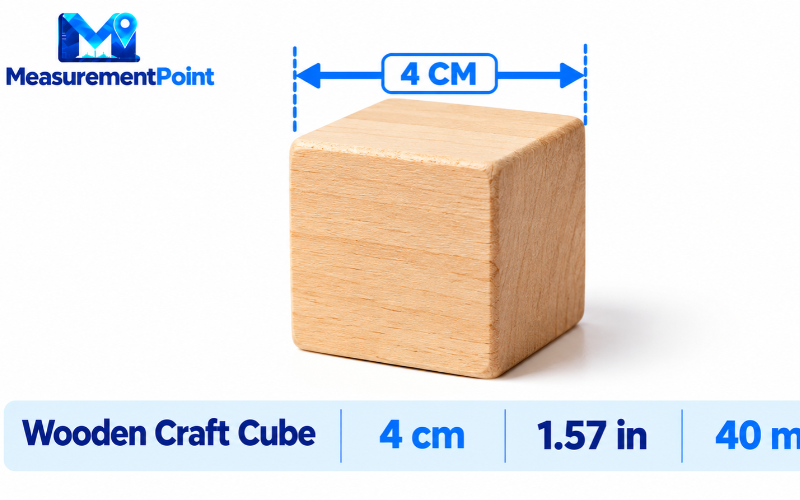
SIDE LENGTH: 4 CM
A small wooden craft cube is a useful way to understand 4 cm because it has straight, easy-to-measure sides. Unlike a ball, which is measured across its center, a cube lets you compare a flat edge with a ruler.
Look for a wooden craft cube that measures 4 cm on each side. Place it on a flat surface and measure one edge from corner to corner.
You can also look at its height and width. If it is a perfect cube, all three dimensions will be the same. Each side will measure 4 cm.
These wooden cubes are often used for school projects, DIY decorations, craft activities, and small learning games. They may come unfinished, painted, or decorated with letters and numbers.
A cube is particularly helpful for younger learners because its straight edges make the measurement easy to understand.
Just check the product dimensions before using one as an exact 4 cm example. Craft cubes are sold in many different sizes.
4. Large Craft Button

DIAMETER: APPROXIMATELY 4 CM
Buttons are usually small, but some large craft buttons measure around 4 cm across. People often use these oversized buttons for handmade decorations, sewing projects, costumes, and art activities.
A button with a diameter of 4 cm gives you a simple round comparison. Measure from one outside edge to the opposite edge, making sure the ruler passes through the centre.
You may find large buttons made from wood, plastic, metal, or fabric-covered materials. Their colours and designs can be very different, but the measurement works the same way.
One thing worth remembering is that button sizes are not standard across every design. Some are much smaller, while decorative buttons can be considerably larger.
For a good comparison, choose a button that measures close to 4 cm in diameter. It is a handy object because it is flat, lightweight, and easy to place beside a ruler.
5. Tea Light Candle

DIAMETER: AROUND 4 CM
A small tea light candle is another useful household comparison. Many standard tea lights have a diameter close to 4 cm, although their exact size depends on the manufacturer.
Look at the circular metal cup around the candle. Its width can help you imagine how much space 4 cm takes up.
These candles are commonly used for decorations, small candle holders, dinner settings, and relaxing home displays. Their compact shape makes them easy to handle and measure.
To check the size, place a ruler across the widest part of the metal cup. Measure from the outer edge on one side to the outer edge on the other.
You can also compare its diameter with a table tennis ball. Both may look similar in width, but the candle is flat on top while the ball is round.
If you are using a tea light for an accurate comparison, check the actual diameter rather than assuming every candle has the same dimensions.
6. Small Craft Pom-Pom

DIAMETER: APPROXIMATELY 4 CM
A fluffy craft pom-pom is a fun way to picture 4 cm. These soft decorative balls are used in school projects, handmade decorations, gift wrapping, and children’s craft activities.
You can find pom-poms in many colours, including red, yellow, blue, pink, and green. They are also available in several sizes. A larger pom-pom measuring around 4 cm across gives you a good idea of this measurement.
Because the material is fluffy, measuring one can be a little tricky. The fibres may spread beyond the main shape. Gently place the pom-pom on a flat surface and measure across its widest point without pressing it down too much.
Imagine holding one in your palm. It takes up a small amount of space, but it is large enough to see clearly.
This example is especially useful for visual learners because its round shape makes it easy to compare with other objects, such as a golf ball or table tennis ball.
7. Short Piece of Chalk

LENGTH: 4 CM
A short piece of chalk measuring 4 cm from end to end is another simple way to understand this length.
You may have used chalk at school to write on a blackboard or draw lines on a pavement. A fresh stick is usually much longer, but after regular use, it can become a small leftover piece.
Imagine holding a piece that is exactly 4 cm long between your fingers. It would be short enough to fit easily in your hand. Its length would be a little more than one and a half inches.
Chalk is usually cylindrical, so you can measure it in two ways. Its length is the distance from one end to the other, while its diameter is the distance across the circular end.
For this comparison, we are only interested in its length.
If you have leftover chalk at home, place it beside a ruler and look for a piece that reaches the 4 cm mark. It is a simple example that does not require any special equipment.
8. Small Sponge Piece

WIDTH: 4 CM
A small piece of sponge can also help you picture 4 cm. Sponges are soft, lightweight, and easy to cut into different shapes, so you can find one with a width close to this measurement.
For this comparison, imagine a small rectangular sponge that is 4 cm wide. It does not need to be 4 cm long on every side. We are only comparing its width.
You may find small sponge pieces in craft kits, cleaning supplies, dishwashing products, and household DIY materials.
The best way to check its measurement is to place it on a flat surface and use a ruler across its widest side. Avoid squeezing the sponge while measuring because the material can compress and give you a different result.
A sponge is a useful comparison because most people have handled one before. You can easily picture the size of a small section without needing to imagine an unfamiliar object.
Choose a piece with a firm, clear edge if you want to use it for a measurement demonstration.
9. Wooden Craft Block
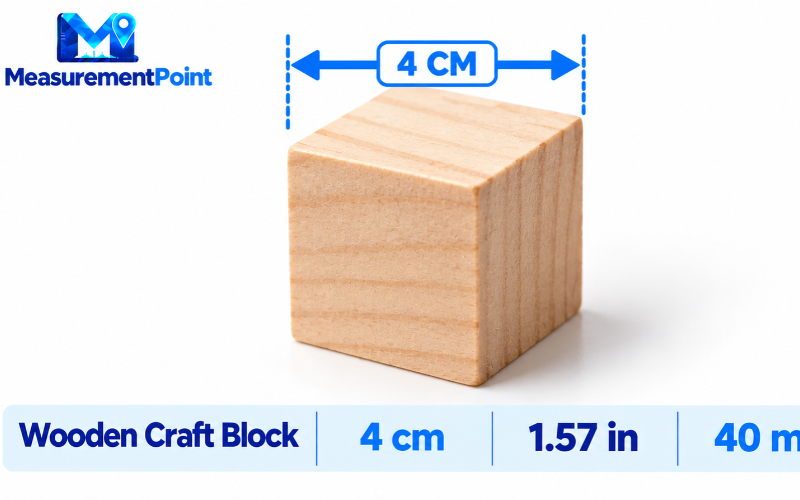
LENGTH: APPROXIMATELY 4 CM
A small rectangular wooden craft block is another practical example of a 4 cm measurement. These blocks are used for DIY decorations, school projects, model building, and small craft activities.
Choose a rectangular block that measures 4 cm along its longest side. Its other dimensions can be different. For example, it might be 4 cm long, 2 cm wide, and 1 cm thick.
This makes it a helpful object for understanding the difference between length, width, and height. You can turn the block in different directions and see how each measurement changes.
Wooden blocks are also easy to measure because they have straight edges and clear corners. Place one side against the zero mark on a ruler and check where the opposite edge ends.
You may find these blocks in natural wood colours or painted finishes. They are small enough to hold comfortably and can give you a clear visual idea of a 4 cm distance.
As with the other adjustable examples, check the dimensions before treating a particular block as exactly 4 cm long.
Related Post: How Long is 20 Inches
How to Measure 4 cm Without a Ruler
You do not always need a measuring tool to get a rough idea of 4 cm. A few familiar objects and simple tricks can help you estimate the distance.
Here are three easy methods:
1. Use a table tennis ball
A standard table tennis ball has a diameter of 4 cm. If you have one nearby, use its width as a reference. Imagine a straight line passing through the centre from one side to the other. That distance is 4 cm.
2. Use a familiar round object
A golf ball is slightly larger than 4 cm, with a diameter of approximately 4.27 cm. You can use it as a close comparison, remembering that it goes a little beyond the target length.
3. Use a small craft block
Find a rectangular wooden block or craft cube that has a measured 4 cm side. Keep it nearby as a reference when estimating other small objects.
These methods are useful when you only need an estimate. If you need an exact measurement for sewing, crafting, construction, or buying something, use a proper ruler or measuring tape.
How Many Inches Is 4 cm?
Four centimeters equals approximately 1.57 inches.
To convert centimeters into inches, divide the centimeter measurement by 2.54.
42.54=1.5748
You can round the result to 1.57 inches for everyday use.
Here is a quick conversion table:
| Centimeters | Inches | Millimeters |
| 1 cm | 0.39 in | 10 mm |
| 2 cm | 0.79 in | 20 mm |
| 3 cm | 1.18 in | 30 mm |
| 4 cm | 1.57 in | 40 mm |
| 5 cm | 1.97 in | 50 mm |
| 6 cm | 2.36 in | 60 mm |
Is 4 cm Big or Small?
Four centimeters is considered a small measurement. It is less than 2 inches and is generally used to describe compact objects, short distances, and small household items.
For example, a standard table tennis ball is 4 cm across. You can hold it in one hand, put it in a small bag, or fit several of them into a drawer.
However, whether 4 cm feels big or small depends on what you are measuring. Four centimeters may be quite large for a tiny electronic component but very small for a piece of furniture.
The easiest way to understand this measurement is to compare it with something familiar. A table tennis ball is particularly useful because its diameter is a standard 4 cm.
See Also
FAQs
How big is 4 cm compared to an inch?
Four centimeters is approximately 1.57 inches. It is a little more than one and a half inches.
Is 4 cm the same as 40 mm?
Yes. One centimeter contains 10 millimeters, so 4 cm equals exactly 40 mm.
What common object is exactly 4 cm wide?
A standard table tennis ball has an official diameter of 40 mm, which is exactly 4 cm. It is one of the most reliable everyday comparisons.
Is a golf ball 4 cm wide?
A regulation golf ball has a minimum diameter of 42.67 mm, or approximately 4.27 cm. It is slightly larger than 4 cm.
Can I use my fingers to estimate 4 cm?
You can use your fingers for a rough estimate, but finger sizes vary from person to person. A ruler or a standard table tennis ball will give you a more reliable comparison.
How do I measure 4 cm accurately?
Place the zero mark of a ruler at one end of the object. Find the point where the other end reaches the 4 cm mark. Make sure the ruler is straight and aligned with the side you want to measure.
How many meters are in 4 cm?
Four centimeters equals 0.04 meters. You can convert centimeters into meters by dividing the measurement by 100.
Conclusion
Now you have nine different ways to picture how big 4 cm is. From a standard table tennis ball to a small wooden craft block, these objects make a short measurement much easier to understand.
The most reliable comparison is a standard table tennis ball because its diameter is exactly 4 cm. Other examples, such as a golf ball, tea light candle, craft button, and sponge piece, can help you visualise a similar size, but their dimensions may vary.
Remember these three measurements:
- 4 cm = 40 mm
- 4 cm = 1.57 inches
- 4 cm = 0.04 meters
The next time you come across a measurement of 4 centimeters, think about the width of a table tennis ball. It is a simple reference that makes the size easy to remember.

One Comment