
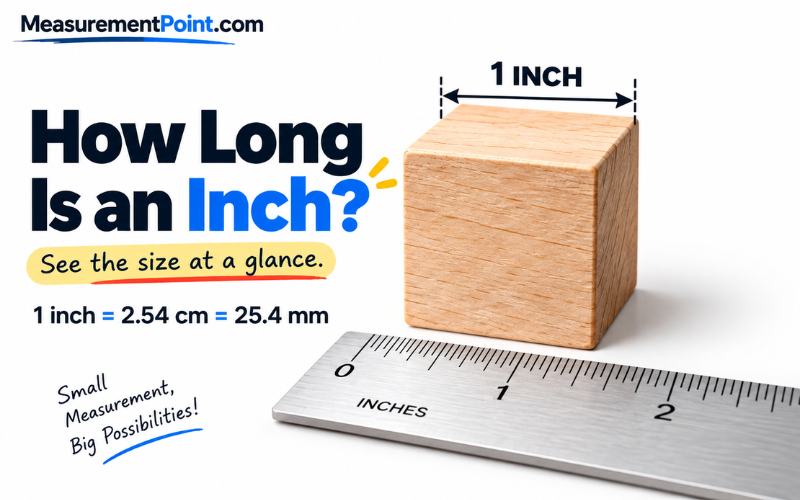
How Long Is an Inch? 10 Common Objects That Help You See the Size
An inch is a small unit of length, but it is used in many things we see every day. One inch is exactly 2.54 centimeters or 25.4 millimeters. On a normal ruler, it is the distance from 0 to the first 1-inch mark.
The problem is that numbers do not always give us a good picture of size. When someone says “one inch,” you may know the number but still have trouble imagining how much space it takes. Looking at a real object can make the measurement much easier to understand.
A one-inch wooden cube, for example, gives you a simple picture because each side is one inch. A hockey puck is another interesting example because its thickness is one inch, even though the puck is much wider. Small magnets, buttons, and other objects can also help you get a feel for the size.
In this guide, we will look at 10 different objects that are 1 inch or have a 1-inch dimension. Some are exact measurements, while a few are only close comparisons. This will help you understand what one inch really looks like instead of just memorizing a conversion.
How Long Is an Inch?
1 inch = 2.54 cm = 25.4 mm.
One inch is also 1/12 of a foot. It is a short distance, about the width of a small object such as a 1-inch button or a little more than the diameter of a U.S. quarter.
The official inch is exactly 25.4 millimeters, so the basic conversion does not need rounding
1 Inch in Centimeters and Millimeters
| Measurement | Equal to |
| 1 inch | 2.54 cm |
| 1 inch | 25.4 mm |
| 1 inch | 1/12 foot |
| 1 inch | 0.0833 feet |
| 1 inch | 0.0278 yard |
The two numbers worth remembering are 2.54 cm and 25.4 mm. Once you know these, it becomes much easier to compare inches with metric measurements.
What Does 1 Inch Look Like?
Think about a line that is 2.54 centimeters long. That is one inch.
It is not a large distance. You can fit 12 inches into one foot, so one inch is only a small part of a foot. At the same time, one inch is large enough to make a noticeable difference when measuring small objects.
A good way to picture it is to look at a ruler. Put your finger at zero and move to the first large number, 1. Everything between those two points is one inch.
You can also use real objects. A one-inch cube gives you an exact three-dimensional example. A one-inch magnet shows what the measurement looks like across a small round object. These examples are often easier to understand than a number alone.
Is One Inch Big or Small?
One inch is a small length.
It is much shorter than a foot and less than 3 centimeters. But small measurements can still be important. A one-inch difference can affect whether a screw fits, whether a small part works, or whether an object fits into a space.
For everyday use, it helps to think of one inch as a short distance rather than trying to imagine the number by itself.
10 Objects That Help You Understand 1 Inch
| Object | 1-Inch Dimension |
| Wooden cube | 1-inch sides |
| Hockey puck | 1-inch thickness |
| Disc magnet | 1-inch diameter |
| Sphere magnet | 1-inch diameter |
| Ring magnet | 1-inch outside diameter |
| Rubber stamp | 1 × 1-inch size |
| Pillar candle | 1-inch diameter |
| Button | About 1 inch |
| U.S. quarter | About 0.955 inch |
| Adult thumb | Roughly 1 inch |
The first examples give you specific product dimensions. The final examples are useful only for rough visual estimates.
1. One-Inch Wooden Cube
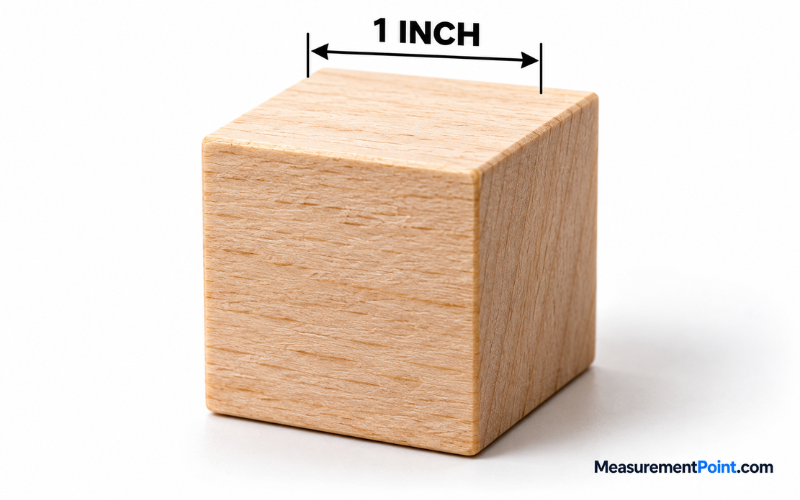
A one-inch wooden cube is probably one of the easiest objects to use when explaining the size of an inch. It has the same measurement on every side, so there is no need to figure out which part of the object is being measured.
A cube that measures 1 inch on each side is 2.54 cm wide, 2.54 cm tall, and 2.54 cm deep. Hold one in your hand and you get a simple physical picture of how much space one inch takes up.
This example is also useful because you can compare it with larger measurements. Two cubes placed side by side would cover 2 inches. Four cubes would cover 4 inches, and 12 cubes would make 12 inches, or one foot.
When you are trying to learn measurements, objects with simple shapes are often the easiest starting point. A one-inch cube is small, easy to handle, and gives you the same measurement in three directions.
2. A Hockey Puck
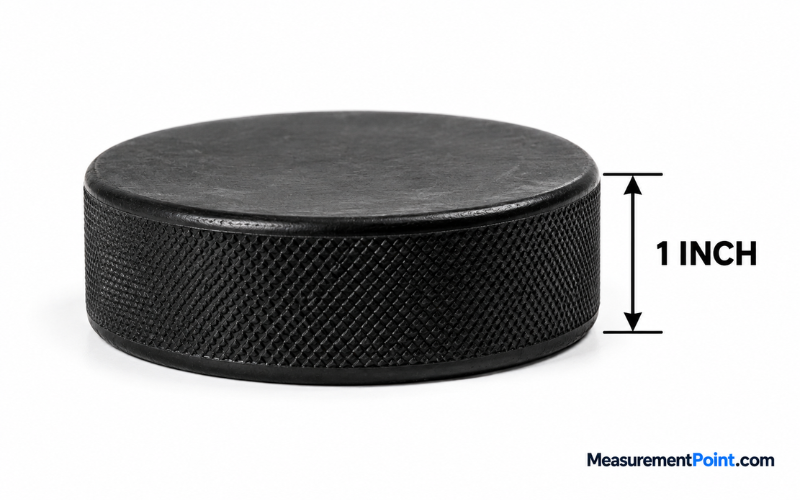
A hockey puck gives you a slightly different way to understand one inch.
A standard hockey puck is 1 inch thick, but it is much wider than one inch. This means you can see how the same object can have different measurements depending on the direction you measure.
Place the puck flat on a table. The distance from the table to the top of the puck is one inch. If you measure across the puck, however, the distance is much greater.
This is an important idea when reading product measurements. When a specification says something is one inch, always check whether it means its length, width, height, thickness, or diameter.
The puck is useful because its one-inch thickness is easy to understand. You can also stack pucks to visualize larger measurements. Two pucks are about 2 inches thick, while three are about 3 inches.
3. A One-Inch Disc Magnet

A one-inch disc magnet gives you a clear example of one inch across a circular object.
The important measurement is its diameter. The diameter is the distance from one side of the circle to the other side through the center.
A disc with a 1-inch diameter measures 25.4 mm across. That is the same as 2.54 cm.
The magnet is much thinner than one inch, but its width across the center is one inch. This makes it a good example of why you should always look at the direction of a measurement.
If you place the magnet beside a ruler, you can compare its diameter with the 1-inch mark. That gives you a much better idea of the size than simply reading “1 inch” on a product page.
4. A One-Inch Sphere
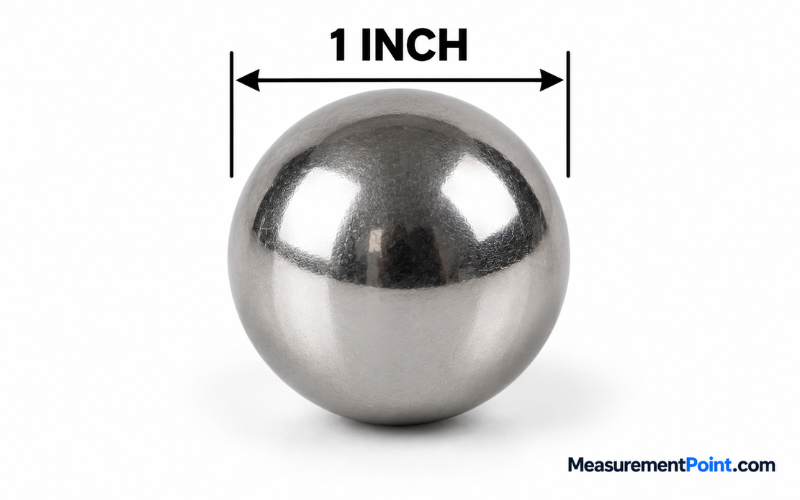
A one-inch sphere is another simple object for understanding the measurement.
Imagine a small round ball that measures one inch from one side to the other through its center. That distance is 2.54 cm.
Unlike a flat disc, a sphere is round in every direction. Its diameter is the same no matter which direction you measure through its center.
This makes a one-inch sphere a good example for understanding diameter. It is also easy to compare with other small objects.
A sphere measuring one inch across is small enough to hold comfortably between your fingers. If you have trouble picturing one inch, seeing a small ball with a known one-inch diameter can make the measurement much clearer.
5. A One-Inch Ring Magnet
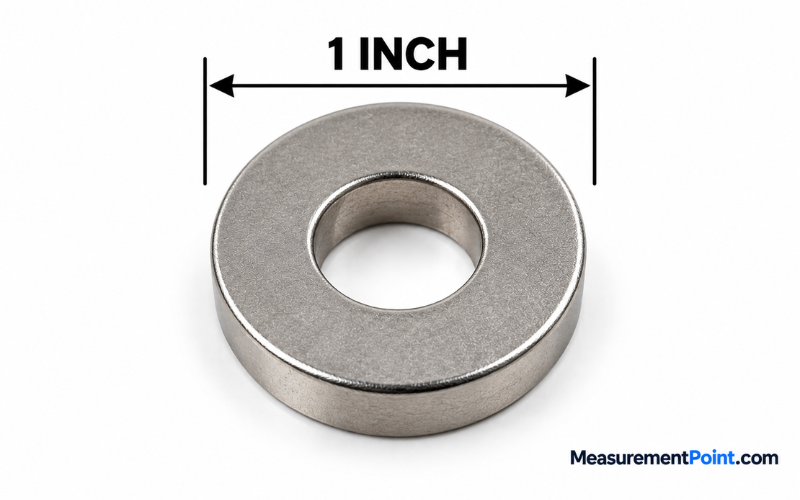
A ring magnet can show another type of one-inch measurement.
A ring can have an outside diameter of 1 inch while the hole in the middle is smaller. So the entire outside width is one inch, but the inside opening has its own measurement.
This is a good reminder that one object can have several dimensions. You might have an outside diameter, inside diameter, and thickness all listed separately.
For a one-inch ring, the outside measurement across the center is 25.4 mm. The thickness and inner hole can be much smaller.
If you put the ring beside a ruler, look at the distance from one outside edge to the opposite outside edge. That is the one-inch measurement you are trying to see.
6. A One-Inch Rubber Stamp
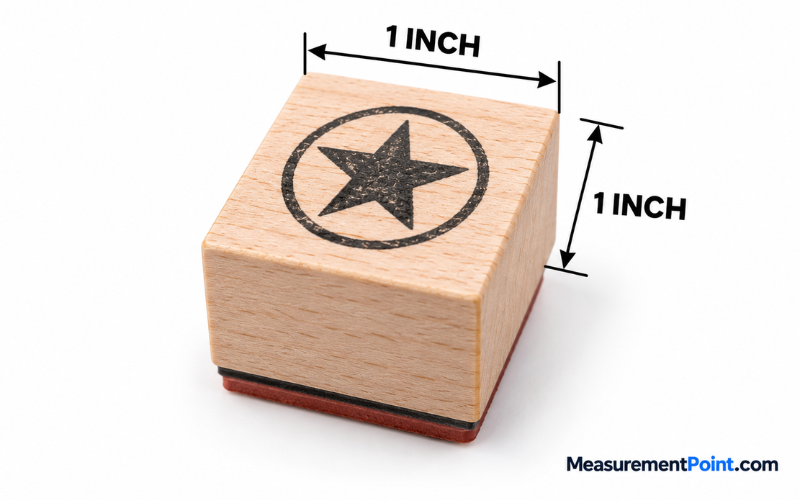
A small rubber stamp can also have a one-inch size.
A square stamp measuring 1 × 1 inch gives you a simple flat example. The stamping surface is one inch wide and one inch tall.
That means the stamping area is about 2.54 × 2.54 cm.
The handle may be much larger, so the whole stamp should not automatically be called one inch. The one-inch measurement applies to the stamping area.
This is another useful lesson when reading product descriptions. Always check what part of the product the measurement describes.
A one-inch stamp is also easy to imagine because you can picture a small square on a piece of paper. The square would be just over 2.5 centimeters on each side.
7. A One-Inch-Diameter Candle
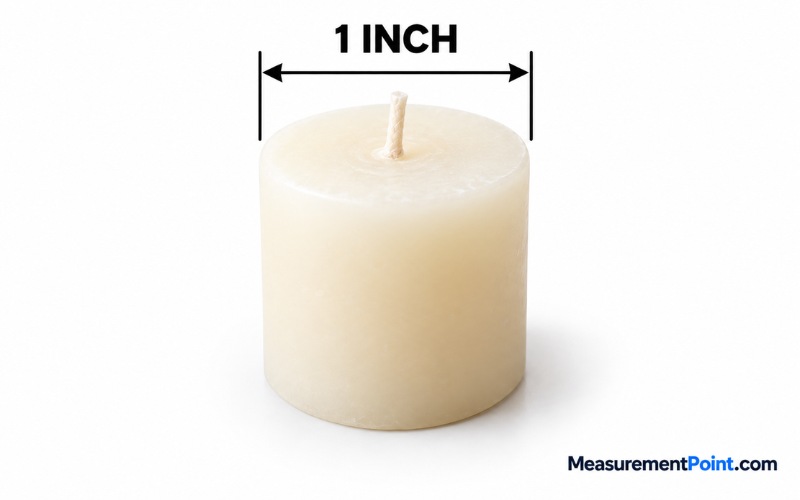
A small pillar candle can provide a good example of one inch as a diameter.
If the candle has a diameter of one inch, the distance across its circular top is 2.54 cm.
The candle can still be several inches tall. So once again, one inch describes only one part of the object.
This is useful because people sometimes assume that saying an object is “one inch” means the entire object is one inch in every direction. That is rarely true for objects with more than one dimension.
When you measure the candle from one side of the circular top to the other through the center, you get the one-inch measurement.
8. A One-Inch Button

A button is a familiar object that can help you picture one inch.
A button described as one inch across is roughly 2.54 cm wide. It is small enough to fit between your fingers and is easy to compare with a ruler.
However, button sizes can vary between manufacturers. Some products use “1-inch button” as a size name rather than a guarantee that the finished button measures exactly 1.000 inch.
So a one-inch button is best treated as a practical visual reference unless its actual dimensions are clearly specified.
Still, it gives you a useful idea of the size. If you imagine a small round button just over 2.5 cm across, you are close to picturing one inch.
9. A U.S. Quarter
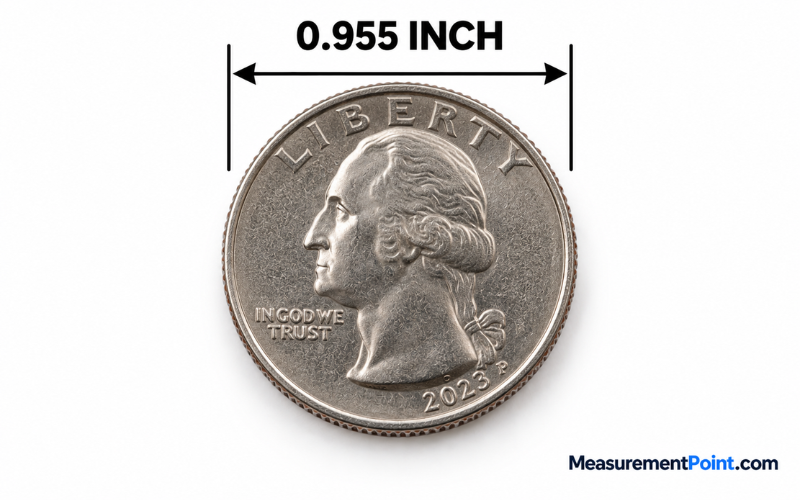
A U.S. quarter is one of the most common objects people use to estimate one inch.
There is one important detail: a quarter is not exactly one inch wide.
Its diameter is about 0.955 inch, so it is slightly smaller than one inch.
That difference is small enough that a quarter can still be useful for a quick estimate. Put a quarter next to the one-inch mark on a ruler and you will see that it falls just short.
This makes the quarter a good example of the difference between an exact measurement and an approximate comparison.
If you need to know whether something is exactly one inch, do not use a quarter as your measuring tool. Use a ruler instead.
10. An Adult Thumb
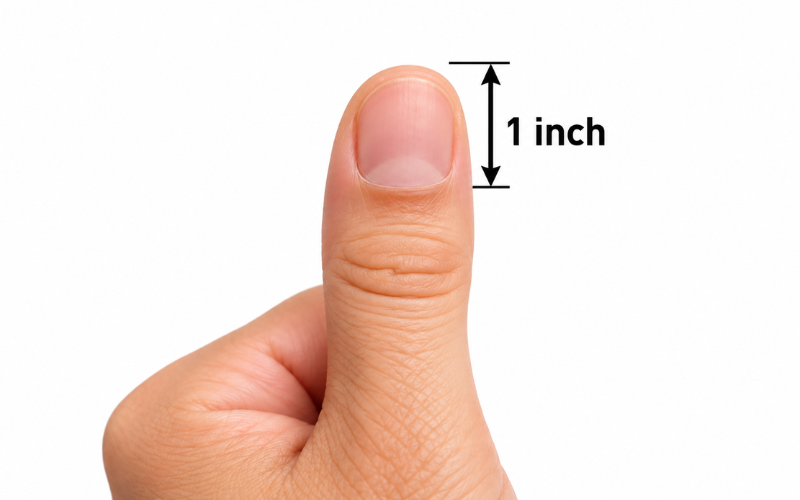
Your thumb can also give you a quick idea of one inch.
For many adults, the width of the thumb is close to one inch. But thumb sizes are different, so this is only a rough estimate.
You can make this method more useful by measuring your own thumb once. If it is close to one inch wide, you can remember that size for quick estimates later.
This method is handy when you are outside or do not have a ruler nearby. It can help you decide whether something is roughly one inch wide.
But if the measurement needs to be accurate, use a ruler. Your thumb is a personal reference, not a standard unit.
How to Measure One Inch Without a Ruler
You can estimate one inch in a few simple ways.
Use your thumb: If your thumb is close to one inch wide, it can give you a quick estimate.
Use a quarter: A U.S. quarter is close to one inch across, although it is slightly smaller.
Use a known one-inch object: A one-inch cube or magnet is a better reference because its size is specified.
Think in centimeters: One inch is 2.54 cm, so 2.5 cm is a very close estimate.
These methods are useful when you only need to know whether something is around one inch. For accurate work, use a ruler or measuring tape.
How to Find One Inch on a Ruler
Finding one inch on a ruler is easy.
Start at the 0 mark. Move along the ruler until you reach the large number 1. The distance between those two marks is exactly one inch.
If your ruler has centimeters on the other side, the same point is at 2.54 cm.
The smaller lines between the inch marks divide the inch into fractions. Depending on the ruler, you may see halves, quarters, eighths, or sixteenths.
This lets you measure objects that are less than or slightly more than one inch.
One Inch Compared With Other Measurements
Here are a few simple comparisons:
1 inch = 2.54 cm
1 inch = 25.4 mm
1 inch = 1/12 foot
2 inches = twice the length of 1 inch
12 inches = 1 foot
25 mm = slightly less than 1 inch
These comparisons can help you build a mental picture of the size.
One Inch vs One Centimeter
One inch is larger than one centimeter.
The exact difference is easy to calculate:
2.54 cm − 1 cm = 1.54 cm
So one inch is more than twice the length of one centimeter.
If you have a metric ruler, one inch reaches a little beyond the 2.5 cm mark.
Why Knowing the Size of One Inch Helps
Knowing what one inch looks like can make everyday measurements easier.
You may need to check the size of a screw, compare a product before buying it, measure a small craft item, check a gap, or see whether something will fit into a small space.
You do not need to carry a ruler everywhere to make a rough estimate. Once you become familiar with one inch, you can use your thumb or a familiar object as a quick reference.
But there is one rule worth remembering: estimate when you only need an idea, and measure when the exact size matters.
FAQs
How long is an inch?
One inch is exactly 2.54 centimeters or 25.4 millimeters.
How long is 1 inch in cm?
1 inch = 2.54 cm.
How long is 1 inch in mm?
1 inch = 25.4 mm.
Is an inch bigger than a centimeter?
Yes. One inch is equal to 2.54 centimeters.
How many inches are in a foot?
There are 12 inches in one foot.
What does one inch look like?
One inch is a small distance. It is 2.54 cm long and can be visualized using a ruler, a one-inch cube, or another object with a known one-inch dimension.
Is a quarter exactly one inch?
No. A U.S. quarter is slightly smaller than one inch across.
Can I use my thumb to measure one inch?
You can use your thumb for a rough estimate, but thumb sizes vary. Use a ruler if you need an exact measurement.
Is 25 mm exactly one inch?
No. One inch is exactly 25.4 mm, so 25 mm is 0.4 mm shorter.
Conclusion
So, how long is an inch? One inch is 2.54 cm or 25.4 mm. It is a small measurement, but it shows up in many products and everyday tasks.
The easiest way to understand it is to stop thinking about the number alone. Look at a one-inch cube, a one-inch magnet, a one-inch button, or even the width of your thumb. Once you have a few real objects in mind, one inch becomes much easier to picture.
For exact measurements, always use a ruler or measuring tape. For quick estimates, familiar objects can help you judge whether something is around one inch.