
How Big Is 1 cm? 8 Common Things That Are Exactly 1 cm Big
One centimeter is a small unit of length, but it is useful for measuring everyday objects, small gaps, and short distances. 1 centimeter (cm) equals 10 millimeters, 0.39 inches, or about 0.033 feet. It is less than half an inch, so it may be difficult to judge by looking at something without a ruler.
If you want to know how big 1 cm is visually, imagine a short line on a metric ruler. The distance between the 0 mark and the 1 cm mark is exactly one centimeter. You can also compare it with familiar objects, such as a small bead, a compact button, or another item with a verified dimension close to 1 cm.
The meaning of this measurement can change depending on the context. Someone measuring a craft project may need to picture one centimeter on a ruler, while someone reading a medical report may be trying to understand the size of a 1 cm tumor, lymph node, gallstone, or kidney stone. These situations involve the same unit, but they require different kinds of information.
This guide explains how big 1 cm is, how to measure it, how it compares with inches and millimeters, and how to understand the measurement in everyday and medical contexts.
How Big Is 1 cm?
1 cm is exactly one-hundredth of a meter and one-tenth of a decimeter. It is also equal to 10 millimeters. In inches, one centimeter is approximately 0.3937 inches, which is slightly less than 0.4 inches.
Here is a quick conversion table:
| Unit | Equivalent to 1 cm |
| Centimeters | 1 cm |
| Millimeters | 10 mm |
| Inches | 0.3937 in |
| Feet | 0.0328 ft |
| Meters | 0.01 m |
One centimeter is shorter than one inch. An inch measures 2.54 cm, so 1 cm is a little less than half an inch.
Related Post: How Long is 25 Inches
How Big Is 1 cm on a Ruler?
On a metric ruler, 1 cm is the distance from the 0 mark to the 1 cm mark. Most metric rulers divide each centimeter into 10 smaller millimeter marks.
To find one centimeter:
- Place the ruler beside the object or space you want to measure.
- Line up one end with the zero mark.
- Find the 1 cm mark.
- Check that the distance between the two marks is 10 millimeters.
Be careful not to start measuring from the physical edge of a ruler if its scale begins a little farther in. Always use the printed zero mark as your starting point.
If your ruler shows only inches, one centimeter is about 0.39 inches. It falls just short of the 0.4-inch point, so it is not quite half an inch.
8 Objects to Help You Visualize 1 cm
The following objects can help you picture a centimeter, but their dimensions vary by brand, design, and material. Treat them as visual references only when the particular item measures close to 1 cm in the dimension described.
1. A Small Craft Bead
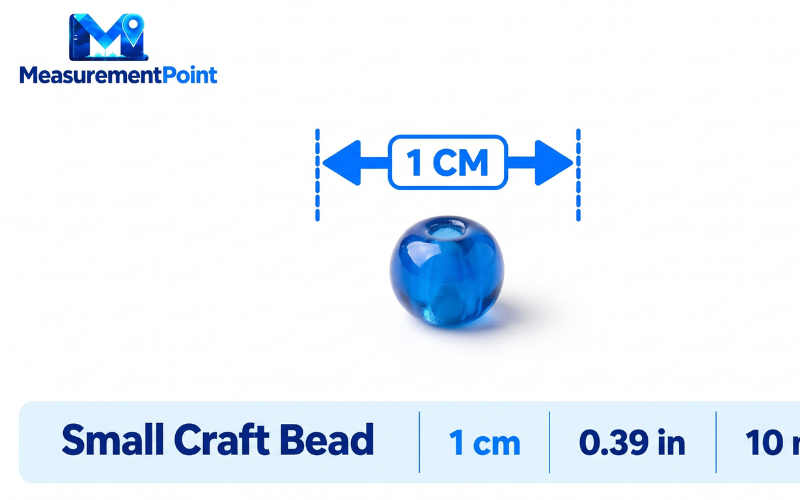
A small craft bead can be a helpful way to imagine 1 cm, provided the bead’s diameter is actually 10 millimeters. Beads come in many sizes, so a bead that looks small is not automatically one centimeter wide.
Picture a round bead lying flat on a table. Its diameter is the straight-line distance from one side to the other through the center. If that distance measures 1 cm, the bead gives you a simple example of the size.
Small beads are used in jewelry making, embroidery, decorative crafts, and clothing accessories. Some are round, while others are cylindrical, oval, or faceted. Their shapes can affect how large they appear from different angles.
For the clearest comparison, measure the widest part of the bead. A bead that is 1 cm across is not necessarily 1 cm tall, especially if it is flattened or has an irregular shape.
2. A Small Shirt Button
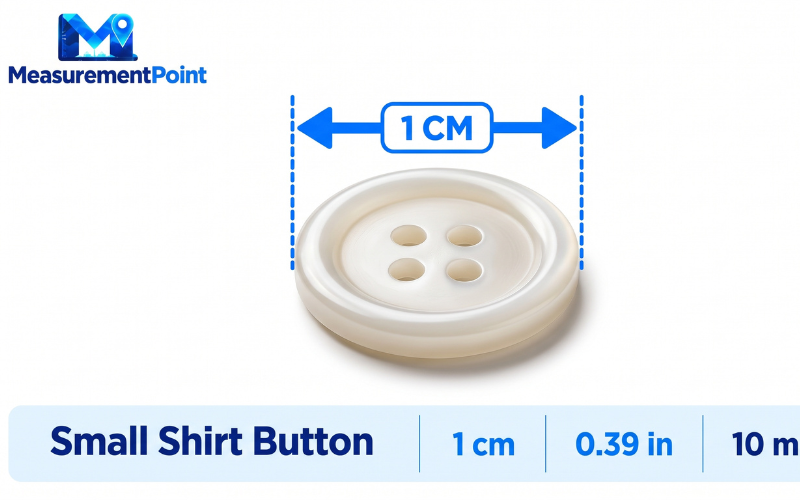
A small shirt button can help you picture a centimeter when its diameter measures 10 mm. Buttons are often used on shirts, blouses, cuffs, and children’s clothing, and they come in a wide range of sizes.
Imagine a round button lying on a flat surface. Measure from the outer edge on one side to the opposite outer edge. If the diameter is 1 cm, the button spans exactly one centimeter.
However, not every shirt button is this small. Some buttons are much wider, particularly those used on coats, cardigans, and decorative clothing. The number of holes in a button does not tell you its size.
A button is a useful visual comparison because it is familiar and easy to handle. If you need an accurate measurement, check the diameter with a metric ruler rather than relying on its appearance.
3. A Small Craft Rhinestone
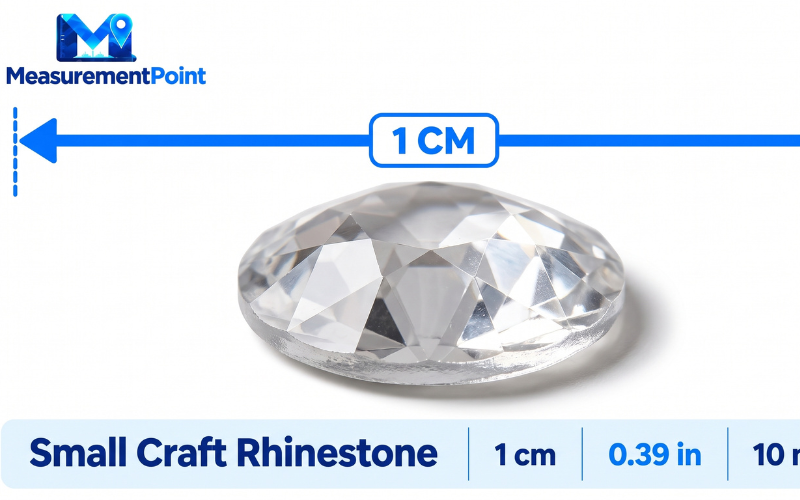
A small craft rhinestone can provide another way to visualize 1 cm. Rhinestones are used to decorate clothing, shoes, greeting cards, accessories, and handmade projects. Some are sold in a 10 mm size, which equals exactly one centimeter in diameter.
The easiest way to compare the rhinestone with 1 cm is to measure across its widest point. The measurement should run from one outside edge to the other, through the center.
Rhinestones can look larger than they are because their cut surfaces reflect light. A raised setting can also make a stone look taller, even when its diameter is only 10 mm.
Check whether the stated size refers to the stone itself or the complete setting. A stone with a 1 cm diameter may take up more space once it is attached to a metal base or decorative mount.
Related Post: How Long is 24 Inches
4. A Small Ceramic Mosaic Tile
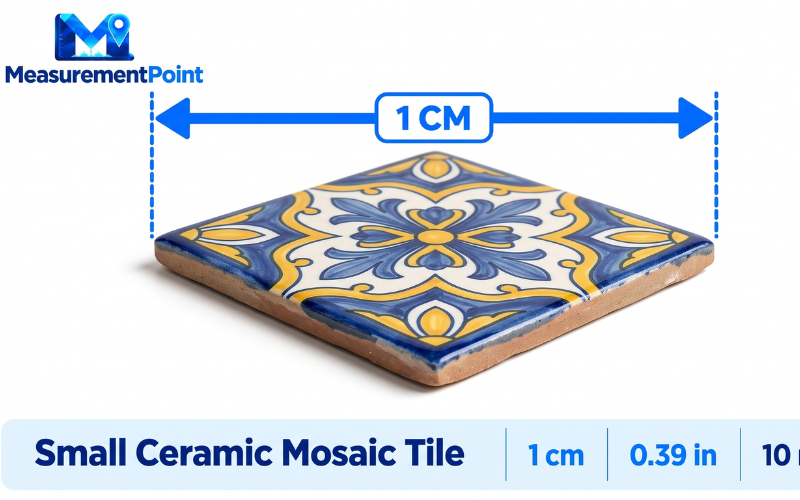
A small ceramic mosaic tile can help you picture one centimeter as a straight distance across a square. Some mosaic sheets contain tiny tiles measuring 10 mm on each side, although many mosaic tiles are larger.
For a square tile, measure from one edge directly to the opposite edge. If each side measures 1 cm, the tile is one centimeter wide and one centimeter tall. Its diagonal would be longer than 1 cm, so make sure you measure a side rather than the diagonal.
Mosaic tiles are used in decorative borders, backsplashes, artwork, and craft projects. They may be made from ceramic, glass, stone, or other materials.
Do not assume that every tile in a mosaic sheet measures one centimeter. Some sheets combine different shapes and sizes. If you need an exact comparison, check the individual tile dimensions on the product packaging.
5. A Small Watch Crown
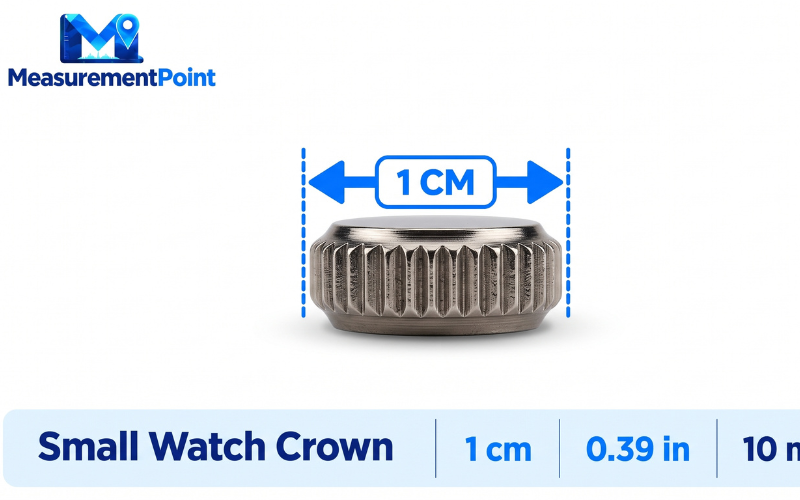
The crown on a wristwatch is the small knob commonly used to set the time or date and, on some watches, wind the mechanism. The crown on a particular watch may have a diameter close to 1 cm.
To understand the measurement, imagine looking directly at the end of the crown. The diameter is the distance across its circular face, from one outside edge to the opposite edge. If that face measures 10 mm, it is one centimeter wide.
Watch crowns vary considerably. A small dress watch may have a tiny crown, while a larger watch may have a wider or more prominent one. The crown’s length, including the stem, is different from the diameter of its outer face.
This example is especially useful because it shows how one centimeter can describe a small component rather than an entire object. For a precise measurement, check the diameter of the crown itself instead of measuring the full watch or its case.
6. A Small Cable Grommet
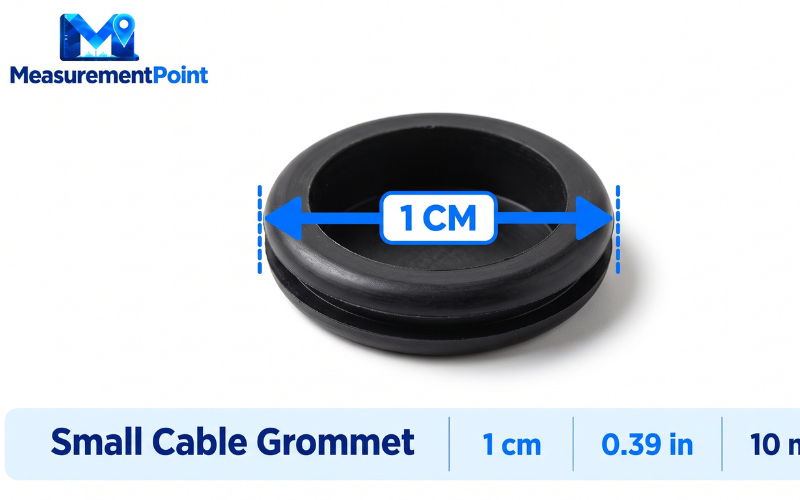
A cable grommet is a ring or fitting that protects cables where they pass through a panel, desk, or enclosure. Small grommets can have an opening or rim dimension close to 1 cm, depending on the model.
Imagine looking straight at the circular opening. If the inside diameter measures 10 mm, the opening is exactly one centimeter across. The outside diameter may be larger because the rubber or plastic ring adds material around the opening.
Grommets are used in desks, electronic equipment, cabinets, and other products where cables need to pass through an opening without rubbing against a sharp edge. They may be made from rubber, silicone, plastic, or metal.
When using a grommet as a comparison, identify which measurement you mean. Its inner diameter, outer diameter, and depth are separate dimensions. A product described as a 1 cm grommet may refer to the hole size rather than the full outside width.
7. A Small Aquarium Pebble
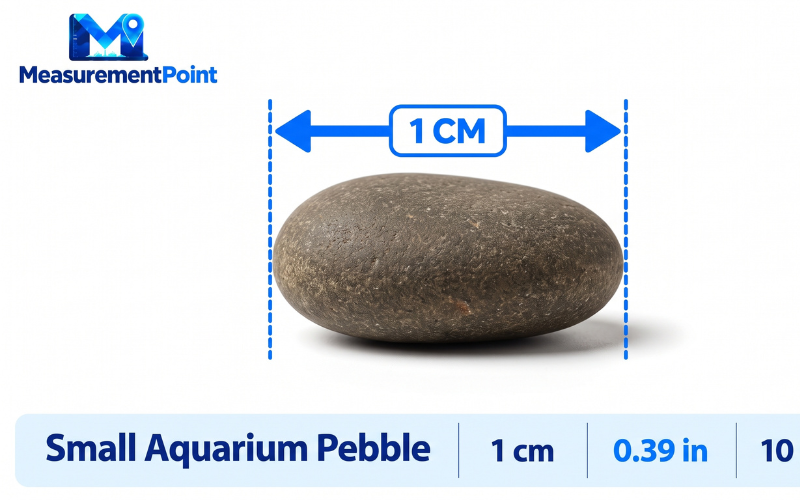
A small aquarium pebble can help you picture a centimeter if it measures about 10 mm across. Aquarium stones vary in size and shape, so choose one with a known measurement if you need an accurate reference.
For a rounded pebble, measure the widest straight distance across it. If that distance is 1 cm, it is the same length as the distance between the zero and one-centimeter marks on a ruler.
Pebbles are often used in aquarium decoration, plant containers, and small craft projects. Some are almost round, while others are flat or irregular. Because of these differences, a pebble can measure 1 cm across but be much thinner from top to bottom.
A pebble is best for a rough visual comparison unless you measure it first. If you are using stones for an aquarium, also choose a type that is suitable for the particular tank and its inhabitants.
8. A Small Electronic Connector Housing
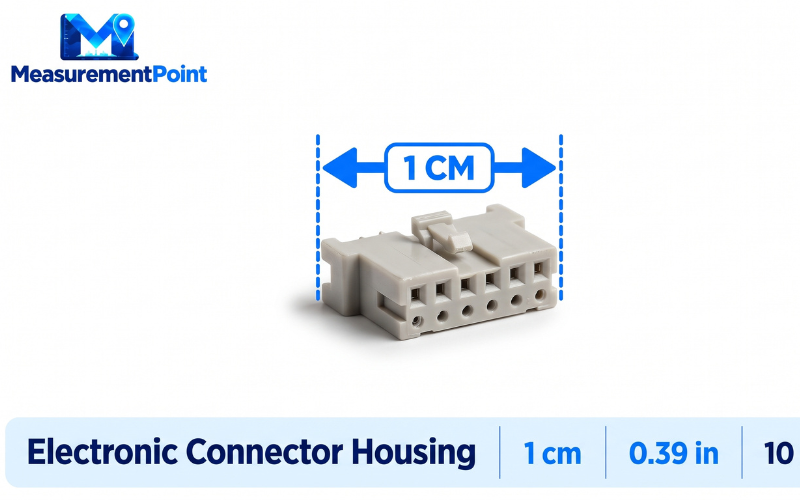
Some small electronic connector housings have a width close to 1 cm. These components are found in cables, compact devices, and electronic assemblies, where they help hold or protect the connection between parts.
Imagine a rectangular connector viewed from the front. If its housing is 10 mm wide, that side measures one centimeter. Its height and depth may be different, so the width alone does not describe the full size of the component.
Connector housings are manufactured in many shapes and standards. Some are designed for very thin cables, while others are wider to accommodate more contacts or stronger connections. A component that looks similar to another may still have different dimensions.
For an exact comparison, use the manufacturer’s drawing or technical specification. Measure the outside of the housing if you want its overall width, or the opening if you are interested in the size of the connection itself.
How Big Is 1 cm in Inches?
One centimeter equals approximately 0.39 inches. It is a little less than half an inch because half an inch is 1.27 cm.
Here is a quick comparison:
| Measurement | Equivalent |
| 1 cm | 0.3937 inches |
| 1 cm | 10 mm |
| 1 inch | 2.54 cm |
| ½ inch | 1.27 cm |
| 1 cm | 0.0328 feet |
If you are looking at a ruler marked in inches, 1 cm falls just short of the 0.4-inch point. If your ruler uses centimeters, it is the distance from zero to the first centimeter mark.
How Big Is 1 cm Actual Size?
The actual size of 1 cm is a length of exactly 10 millimeters. It does not change based on the object, the ruler, or the screen you use to view it.
However, an image of a one-centimeter line may not appear at its real-world size on your phone or computer. The display’s resolution, zoom level, browser scaling, and screen dimensions can change how large it looks.
To see 1 cm at actual size, use a physical ruler. Line up the beginning of the measurement with zero and look at the 1 cm mark. This gives you a dependable reference regardless of the device you use.
How to See 1 cm Actual Size on a Screen
If you search for “show me how big is 1 cm,” you may find images of a line or square labeled 1 cm. These can help explain the measurement, but an online image is not guaranteed to display at actual size.
To compare a screen image with a real centimeter:
- Open an image that clearly labels a 1 cm line.
- Place a physical metric ruler against the screen only if doing so is safe for the display.
- Compare the line with the ruler’s zero and 1 cm marks.
- If the sizes differ, remember that the image is illustrative, not a calibrated measurement tool.
Do not rely on a screenshot or online image for a precise measurement unless its scale has been calibrated for your particular screen. Browser zoom and device settings can change the displayed size.
How Big Is 1 cm in Height?
When someone asks how big 1 cm is in height, they usually mean a vertical distance of one centimeter. It is the same length as 1 cm measured horizontally; only the direction changes.
For example, a mark that extends 1 cm upward on a wall has a vertical height of one centimeter. A small component that measures 1 cm from its base to its top has a height of 1 cm, even if its width is greater.
It is important to identify the endpoints. The height of an object is not always the same as its width or depth. On a round object, a diameter across the middle and a vertical height can be different measurements.
How Big Is 1 mm Compared With 1 cm?
One centimeter equals 10 millimeters, so one millimeter is one-tenth of a centimeter.
| Unit | Size |
| 1 cm | 10 mm |
| 5 mm | 0.5 cm |
| 2 mm | 0.2 cm |
| 1 mm | 0.1 cm |
On a metric ruler, the short marks between two centimeter numbers usually represent millimeters. Count ten millimeter intervals to move from one centimeter mark to the next.
A millimeter is useful for describing very small differences, such as the thickness of a thin sheet or a small gap. A centimeter is often easier to use when measuring slightly larger objects.
How Big Is a 1 cm Tumor?
A tumor measuring 1 cm is 10 mm across in the dimension being reported. To visualize the length, imagine a line that extends from the zero mark to the 1 cm mark on a metric ruler.
However, tumor size alone does not determine whether a tumor is benign or cancerous, how serious it is, or what treatment is needed. Those questions depend on factors such as the tumor’s location, type, appearance, test results, and whether it has spread.
Tumors also have three dimensions. A report might describe a mass as 1 cm in one direction while its other dimensions are different. A measurement of 1 cm does not necessarily mean the entire mass is a perfect sphere or that it has a volume of 1 cubic centimeter.
If a scan or medical report mentions a 1 cm tumor or mass, ask the treating clinician what the measurement means in your specific case. Do not use a size comparison alone to assess a diagnosis.
How Big Is a 1 cm Lymph Node?
A lymph node described as 1 cm has a reported measurement of 10 mm in the specified direction. Lymph nodes are small structures that are part of the immune system, and their size can vary depending on their location and other factors.
The significance of a 1 cm lymph node cannot be determined from size alone. Clinicians may consider its location, shape, internal appearance on imaging, symptoms, medical history, and whether it changes over time. The measurement used in a report may also refer to a particular dimension rather than the entire node.
If a scan reports a lymph node measuring 1 cm, discuss the finding with your healthcare professional. The context of the scan matters more than comparing the measurement with a small everyday object.
How Big Is a 1 cm Gallstone?
A gallstone measuring 1 cm is 10 mm across in the dimension being described. You can picture it as a small stone that spans the distance from the zero mark to the 1 cm mark on a metric ruler.
Gallstones can differ in size, shape, and number. A 1 cm stone may be round, oval, or irregular rather than perfectly spherical. Its measurement alone does not establish whether it will cause symptoms or require treatment.
The location of the stone and whether it blocks a duct are important considerations. If you have been told that you have a 1 cm gallstone, a clinician can explain what the finding means alongside your symptoms and imaging results.
Seek urgent medical care if you experience severe or persistent abdominal pain, particularly with fever, repeated vomiting, or yellowing of the skin or eyes.
How Big Is a 1 cm Kidney Stone?
A kidney stone measuring 1 cm is 10 mm across in the dimension being reported. It is a small object by everyday standards, but a stone of this size can still be medically significant.
Kidney stones vary in shape and may have rough or jagged surfaces. A report may give one measurement or several dimensions, and the longest dimension is not always the same as the width.
Whether a kidney stone can pass on its own depends on factors beyond size, including its location, shape, and the person’s anatomy and health. Do not assume that a 1 cm stone will pass without medical help. A healthcare professional can explain the scan results and appropriate next steps.
Seek urgent medical assessment for severe pain with fever or chills, difficulty passing urine, or feeling seriously unwell.
How Big Is 1 cm Dilated?
In labor, cervical dilation describes how far the cervix has opened. One centimeter dilated means the opening is measured at 1 cm, or 10 mm, rather than describing the height or diameter of a separate object.
Cervical dilation is commonly recorded in centimeters during labor, with 10 cm generally considered full dilation. A measurement of 1 cm means the cervix has begun to open, but it does not predict exactly when labor will progress or when a baby will be born.
Labor progress varies from person to person. A single dilation measurement is only one part of the clinical picture; contractions, changes over time, the baby’s position, and other factors also matter. If you are pregnant and unsure what your measurement means, ask your maternity care team to interpret it in your situation.
See Also
FAQs
Is 1 cm bigger than 1 inch?
No. One inch equals 2.54 cm, so 1 cm is much shorter than 1 inch. One centimeter is approximately 0.39 inches.
How many millimeters are in 1 cm?
There are exactly 10 millimeters in 1 centimeter. To convert centimeters to millimeters, multiply the centimeter measurement by 10.
How do I measure 1 cm without a ruler?
Use an object with a verified 10 mm dimension as a reference, or mark the distance using a calibrated measuring tool. Guessing by sight is less accurate.
Can I see 1 cm actual size on my phone?
You can view an image labeled 1 cm, but it may not appear at actual size. Screen dimensions, zoom, and display settings affect its appearance.
Is a 1 cm tumor considered large?
A 1 cm tumor measures 10 mm in the reported dimension. Whether it is concerning depends on its type, location, test results, and other clinical findings—not size alone.
Is a 1 cm kidney stone large?
A 1 cm kidney stone measures 10 mm and can be medically significant. Whether it passes naturally depends on its location, shape, and individual circumstances.
What does 1 cm dilated mean during pregnancy?
It means the cervix has opened to a measurement of 1 cm. This is an early dilation measurement and does not predict exactly when labor will progress.
Conclusion
One centimeter is a short but useful unit of measurement. It equals 10 millimeters, approximately 0.39 inches, and 0.0328 feet. On a metric ruler, it is the distance between the zero mark and the 1 cm mark.
Small craft beads, shirt buttons, rhinestones, mosaic tiles, watch crowns, cable grommets, aquarium pebbles, and electronic connector housings can help you picture the size when their relevant dimensions are verified.
For an exact measurement, use a ruler or measuring tool rather than relying on an object’s appearance or an image on a screen. And when a 1 cm measurement appears in a medical report, remember that its meaning depends on the medical context, not just the number itself.

One Comment